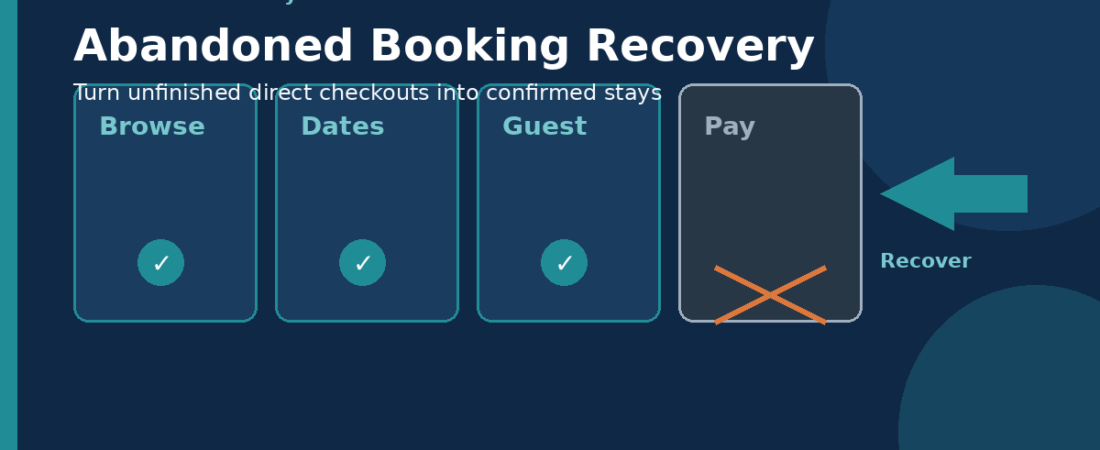
A guest finds your hotel, opens the booking engine, picks dates, maybe even types a name — then leaves. That session cost you something: Google Hotel Ads, SEO, a metasearch click, or years of brand work. Most independents never see a clean number for how often it happens, so they treat it as “comparison shopping” and move on.
Abandoned booking recovery is the quieter half of direct-channel work. It is not brand-search defense and it is not another OTA promotion. It is a workflow: capture intent, remove friction, and follow up while the trip is still being planned — without training guests that walking away earns a discount.
This guide is for GMs and owners who already care about direct bookings. It draws on published 2026 hospitality email benchmarks and practical booking-engine recovery write-ups. No invented rankings, and no promise that your property will hit someone else’s conversion percentage.
What “abandonment” actually means
Hotel booking abandonment is when a guest starts a reservation path and leaves before confirmation. Published rates often sit in a wide band (roughly mid‑60% to mid‑80% of booking sessions, depending on who you ask), but those figures are not interchangeable.
Noovy’s 2026 tactical guide makes the measurement point clearly: a vendor quoting ~70% and an analytics tool quoting ~85% may describe the same hotel if one counts people who opened the booking engine and the other counts all website visitors. Before you set a target, pick one denominator and stick to it:
| Denominator | What it counts | How it behaves |
|---|---|---|
| All website visitors | Everyone on the site | Highest “abandon” rate; includes no-intent traffic |
| Booking-engine users | People who opened the widget/engine | Most useful ops number |
| Guests who began details | People who started the form | Lowest rate; often what vendors quote |
Browse abandonment (looked at rooms, never opened the engine) and booking-engine abandonment need different fixes. Blending them into one “conversion problem” leads to the wrong tools.
Why recovery matters for independents
Independent hotels feel abandonment twice. First, you paid to acquire the visitor. Second, a share of abandoners finish on an OTA — so you lose the stay and pay commission if they rebook elsewhere.
You do not need heroic percentages for the math to matter. Noovy’s conservative planning example shows that even a low single-digit recovery of booking-engine abandoners can add meaningful room nights over a year for a small hotel — treat that as an illustration, not your forecast.
On the email side, Revinate’s 2026 Hospitality Benchmark Report (North America) shows cart abandonment as the top-converting recurring campaign type at 6.80% conversion in their dataset, with cancellation recovery contributing the most volume. Related Revinate commentary cites cart-abandonment emails around a 63% open rate and 6.8% conversion. Those are campaign benchmarks across participating hotels, not a guarantee for your list, brand, or booking engine.
Where guests actually drop off
Across trade and booking-engine write-ups in 2026, the same friction patterns show up. Work them in order; one afternoon of watching session recordings usually finds the largest leak:
- Price surprise — Rate looks clean on the grid, then taxes/fees jump at checkout. Show inclusive pricing early.
- Forced account creation — Independents rarely have loyalty gravity that justifies a mandatory signup before pay.
- Long forms — Dietary preferences and pillow type can wait until check-in.
- Unclear policies — Cancellation and deposit terms buried until the card page create hesitation, not trust.
- Payment failure UX — Generic “try again” errors after 3‑D Secure or a soft decline send high-intent guests to an OTA that just works.
Prostay’s June 2026 piece (vendor sample of 22 independents) makes the same point: step-level drop-off beats one blended conversion rate, and mobile form/payment friction often dominates the recoverable slice. Treat vendor samples as hypotheses for your funnel — not industry law.
The recovery sequence that respects the guest
Most sequences fail for one boring reason: the booking engine never captured an email before payment. If most abandoners leave earlier, you have nothing to message.
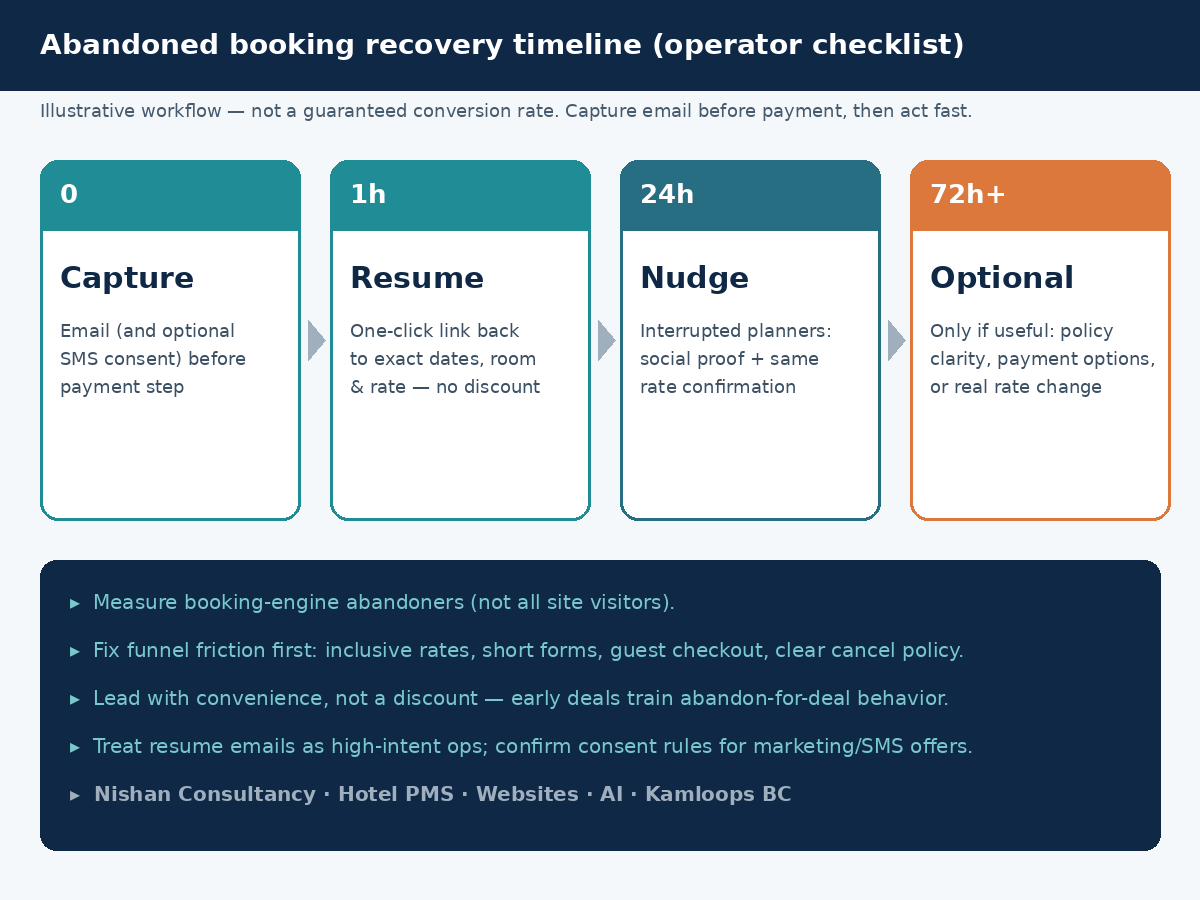
When contact data exists, timing matters more than clever copy. A practical cadence used across 2026 operator guides:
Within about one hour — resume, don’t discount
Booking intent is still warm. Send a short message whose only job is a one-click return to the same dates, room, and rate. Rebuilding a search from scratch is itself a reason to abandon again.
Do not lead with a discount. Noovy’s guide argues most early abandonment is friction, interruption, or uncertainty — not price. An immediate deal teaches guests that walking away is how your hotel negotiates.
Within about 24 hours — catch interruptions
Work meetings, school pickup, bad mobile signal. A second touch can restate the hold or availability reality and make the path back obvious. After roughly a day, natural re-engagement falls off sharply.
Final touch — only if it adds information
A third message without new information trains people to ignore you. Useful triggers include a real rate change on those dates, a genuine sell-down, or clearer payment/cancellation options — not a fake countdown timer.
Prostay claims a four-message cadence recovered 8–12% of abandoners in their sample versus 1.5–3% for a single email — their sample, not a promise. Start with a measurable two-touch resume sequence, then expand.
SMS — narrow, consented, high ADR
SMS can help a small high-intent segment with clear opt-in. Broad cart SMS creates unsubscribe and carrier risk. Prefer payment-step abandoners and one restrained message.
Prevention beats recovery
The cheapest abandoned booking is the one that never abandons. Before you buy another marketing tool, fix the path that sits under hotel website and booking-engine work:
- Inclusive rates from the first display
- Guest checkout (optional account after confirmation)
- Short forms; collect niceties later
- Cancellation and deposit terms visible before pay
- Local payment methods your guests actually use
- Mobile path that survives autofill, keyboards, and 3‑D Secure return URLs
- Brand continuity from marketing site into the engine (no “who stole my site?” moment)
- Email capture before payment so recovery is even possible
If your site already fails a basic conversion audit, recovery email is putting a bandage on a broken checkout. Pair this article with the onsite checklist in Signs Your Hotel Website Is Costing You Guests.
Privacy: resume vs marketing
A message that helps someone finish a booking they started is not the same as a promotional blast. In the EU and other consent-heavy markets, lawful basis can differ between a transactional resume and a marketing offer (for example, a percent-off voucher). Noovy flags this distinction explicitly. Confirm your own basis and consent records with qualified counsel before you launch — especially before SMS or discount copy.
Canadian and US properties still need clean unsubscribe handling and honest “why am I getting this?” language. When in doubt, make the first message a resume link, not a sale.
A GM checklist for this week
- Pick a denominator — booking-engine sessions for the last 30 days; abandon rate and completed bookings.
- Find the cliff — which step loses the most people (results, guest info, payment)? Watch ten session recordings if you can.
- Ask your booking engine vendor — can you capture email before payment, and fire an abandoned-cart event with a resume URL?
- Ship a two-email test — ~1 hour and ~24 hours; convenience only; track recovered bookings, not just opens.
- Align marketing creative — if you retarget abandoners, do not advertise a lower public rate than the engine shows.
- Decide ownership — who owns the sequence: revenue, marketing, or the GM? Recovery dies when it is “everyone’s job.”
How this maps to Nishan’s work
Abandoned booking recovery sits across three lanes Nishan Consultancy already serves:
- Hotel Marketing & Management — demand you paid for should not leak silently; recovery sequences and direct-first reporting belong here.
- Website Design & Development — funnel friction (mobile, forms, engine handoff) is a website/booking-path problem first.
- Workflow Automation — event triggers, resume links, and exception alerts are ops workflows, not one-off campaigns.
Marketing support is still referred carefully when it is outside scope; workflow automation is a scoped add-on for existing PMS clients. If you want a straight read on whether your leak is funnel UX, missing capture, or a half-built sequence, start from Services or request a demo / free audit and contact.
For the wider direct-channel picture, see also Why Independent Hotels Lose Direct Bookings to OTAs.
Honest caveats
- Benchmarks and vendor samples are not your property’s forecast.
- Recovery cannot fix chronic rate parity chaos or a booking engine that cannot hold a resume state.
- Over-messaging high-intent guests will burn trust faster than it recovers rooms.
- Nishan Consultancy does not guarantee a recovery percentage. We help you measure the funnel, remove obvious friction, and wire a sequence your team can actually run.
FAQ
What is a good hotel booking abandonment rate?
There is no single good number without a denominator. Track booking-engine sessions separately from all-site traffic, then improve step-level drop-off.
Should the first recovery email include a discount?
Usually no. Lead with a one-click resume. Reserve incentives for rare later cases that do not train abandon-for-deal behavior.
Is cart abandonment email worth it for a small independent?
Revinate’s 2026 North America benchmarks put cart abandonment among the strongest recurring email conversions in their set. Small, targeted lists often outperform giant blasts — if you can measure recovered bookings.
What if our booking engine cannot send recovery emails?
Push incomplete-reservation events to a CRM/ESP if the engine allows it. If email is never captured before payment, fix capture first.
Nishan Consultancy — Hotel PMS · Websites · AI · Kamloops BC · (+1) 778-538-0702 · info@nishanconsultancy.com