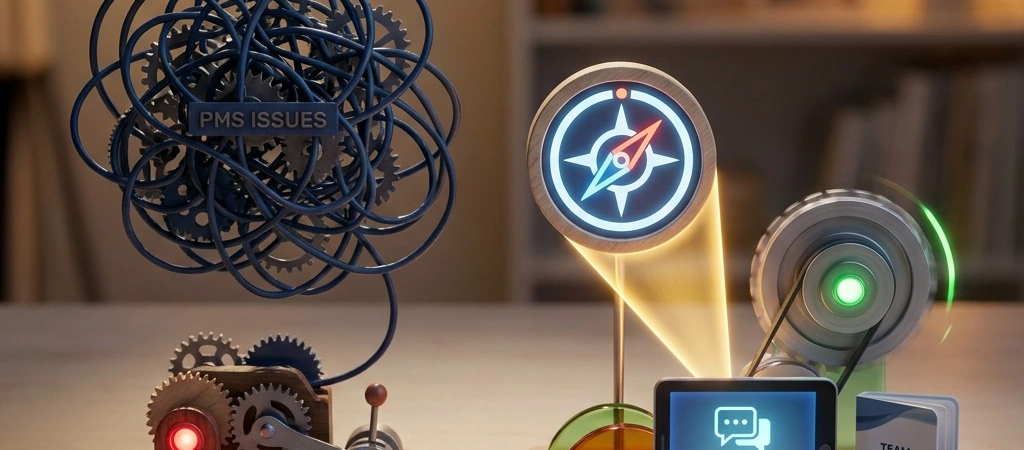
A PMS migration fails in public: double bookings, missing deposits, f

ront-desk confusion, and angry in-house guests. The root cause is usually unclean guest data, incomplete field mapping, and a cutover plan that treats go-live like a software install instead of an operations event.
This guide is for independent hotels and small groups moving between Oracle OPERA Cloud, Cloudbeds, Mews, or any comparable cloud PMS without freezing reservations or losing the guest relationship.
Key takeaways
- Treat migration as a data-mapping and reconciliation project, not a file copy.
- Prioritize future reservations, open folios, deposits, consent flags, and high-value guest profiles; archive noisy history.
- Payment card tokens often cannot move between gateways—plan deposits and guaranteed reservations early.
- Run test imports and parallel validation before cutover; keep the old PMS read-only for a defined rollback window.
- Train the night auditor and front desk on day-one exception handling.
Why guest-data migrations break hotels
Different data models
Opera commonly structures complex stays with segments and legs; Mews and Cloudbeds use their own reservation and item models. Rate plan, package, and market code fields rarely map one-to-one.
Dirty profiles multiply
Independent hotels accumulate duplicate profiles, bad emails, and obsolete addresses. Importing them uncleaned recreates the mess and confuses loyalty recognition on arrival.
Money state is easy to get wrong
Open balances, advanced deposits, and OTA virtual-card guarantees must arrive with clear remaining amounts. A prepaid guest should never be asked to pay again because a folio did not transfer.
What to migrate vs. archive
| Data class | Approach | Notes |
|---|---|---|
| Future reservations | Migrate | Confirmation IDs, rates, occupancy, requests, source |
| In-house and cutover arrivals | Migrate + verify | Highest-risk set |
| Active or VIP profiles | Clean then migrate | Deduplicate first |
| Closed historical folios | Archive | Keep a searchable export |
| Full PAN / CVV | Never migrate | Use tokens or new authorizations |
Pre-migration checklist
- Freeze scope: define source, destination, go-live date, properties, and what done means.
- Profile the mess: count future reservations, missing contacts, duplicates, company accounts, and nonzero deposits.
- Build a field-mapping workbook: source field → destination field → transformation → empty-value rule → owner.
Test plan that prevents surprises
- Sandbox-import a sample week with arrivals, departures, stayovers, groups, and day-use.
- Reconcile reservations, room nights, ADR, deposits, and open balances.
- Test shared rooms, connecting rooms, child ages, tax exemptions, no-shows, and modifications.
- Dry-run Booking.com and Expedia channels, then verify the website and Google path.
- Rehearse a front-desk check-in and mock night audit.
Cutover playbook
T−14 to T−7
- Lock new rate creation in the old PMS except emergencies.
- Finish OTA mapping in the destination and publish an internal FAQ.
T−1 and go-live
- Export future reservations and open balances; name an escalation tree.
- Import the final delta, spot-check 72 hours of arrivals, and flip channels and website to the new PMS.
- Keep the old PMS read-only for folio research.
T+1 to T+14
Reconcile arrivals, inventory, and deposits daily. Log every manual exception and disable dual entry once variance is stable.
FAQ
How long does a small-hotel PMS migration take?
For a clean 40–100 room independent, six to twelve weeks is a common planning range. Complex rate structures and multi-property centralization take longer.
Can we migrate only future bookings?
Yes. Keep a searchable archive of historical folios and migrate enough stay history for repeat recognition.
Will guest credit cards transfer automatically?
Often no. Tokenization is gateway-specific; plan procedures for guaranteed reservations before go-live.
Soft next step: Nishan Consultancy supports operations-safe PMS transitions across Opera, Cloudbeds, and Mews.