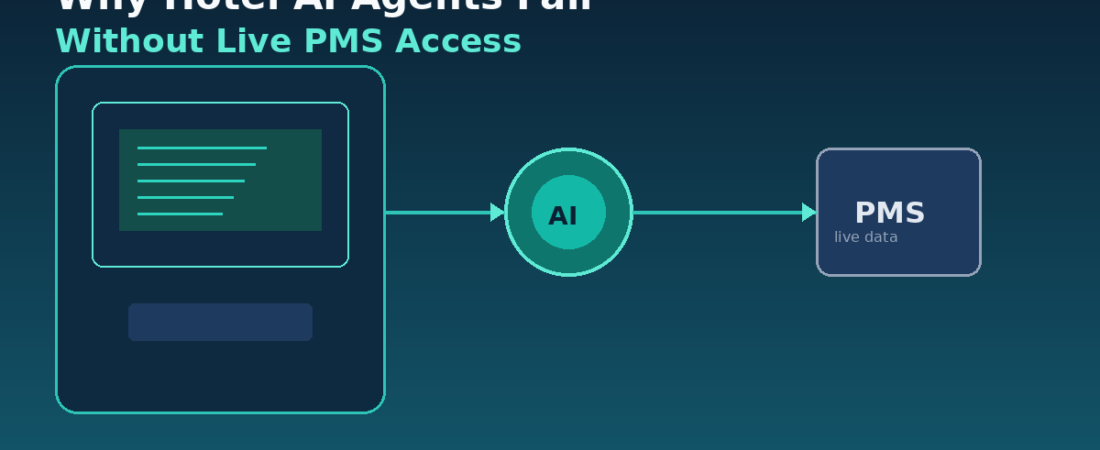
Why Hotel AI Guest Agents Fail Without Live PMS Access
After-hours FAQ that is allowed to answer only from approved content plus
Early / late check-in and arrival-ETA handling backed by live reservation and room status, with clear escalate-to-duty-manager rules.
Run it 30 days. Measure: after-hours tickets handled without desk touch, wrong answers escalated, and minutes of re-keying removed — not vanity “messages automated” counts.
Related distribution pain (brand-intent guests steered to OTAs before they ever chat with your agent) is covered in our piece on brand-search hijacking and direct bookings. Fixing the agent without a trustworthy direct path still leaves money on the table.
How Nishan approaches AI guest agents
At Nishan Consultancy, AI Agent Building sits next to PMS Issues and Workflow Automation on purpose. We design agents around PMS-aware boundaries: what may be read, what may be written, and when a human must own the thread. We prefer boring, testable workflows over “do everything” demos.
Honest caveats: we do not invent client ROI in this article. Case studies on site are illustrative until verified. Outcomes depend on your PMS API quality, data hygiene, staff training, and how tightly you scope the first workflow. There is no guarantee that any agent will cut night calls by a fixed percentage.
If you want a scoped review of whether your Opera / Cloudbeds / Mews stack can support a safe guest agent — or help wiring the first after-hours workflow — request a demo or contact us. Phone (+1) 778-538-0702 · email info@nishanconsultancy.com.
FAQ
Is a website chatbot enough for after-hours guests?
It is enough for static facts (Wi‑Fi, parking address, pool hours) if those pages stay accurate. It is not enough for early check-in, room readiness, or folio questions that need live PMS data.
Do we need a full custom agent stack?
Usually no for a single independent property. Guestara’s trade commentary argues most independents lack the unified data and engineering budget enterprise stacks assume.
What is the fastest red-flag in a vendor demo?
Scripted answers that never open your test reservation, or “integration” that only syncs the initial booking and ignores later room moves and modifications (a failure mode Hotel Tech Insight documents for check-in flows).
Will live access mean the AI can change anything in the PMS?
It should not. Good designs use least-privilege write scopes, confirmation steps for money-moving actions, and mandatory escalation for cancellations, compensations, and safety issues.
Sources (public / trade)
1. Guestara — AI Agent for Hotels: What Actually Works in 2026 (FAQ vs agent; independent-hotel data/API gaps; start with one workflow; Phocuswright ~60% agentic AI experimentation as reported there).
2. Jurny Blog — Why Most PMS AI Is Failing STR Operators (FAQ bolt-ons vs bidirectional live reservation access; early check-in calendar example).
3. Hospitality Net — opinion on PMS integration requirements (data mapping, events, ownership; messy-scenario testing).
4. Hotel Tech Insight — Hotel PMS Integrations 2026 (polling vs real-time; check-in sync failure modes).
5. Akia — Mari Jean Hotel case study (vendor illustration of serverside re-entry pain when messaging is not two-way with Mews).
Published for Nishan Consultancy · Kamloops BC · Hotel PMS, websites, and AI agents for independent hotels.
1. Field map in writing — which reservation, guest-profile, room-status, and charge fields sync each direction?
2. Event vs poll — webhooks / direct API, or interval polling? What is the worst-case lag overnight?
3. Early check-in scenario — demo against a live calendar conflict and a cleaning window; require an honest denial path.
4. Write-back boundaries — list every field the agent may change; default deny everything else.
5. Error surfacing — when the PMS link drops at 2 a.m., who is alerted, and how do guests get human help?
6. Audit trail — can you replay what the agent read and wrote for a dispute or GDPR request?
7. PMS realities — Opera Cloud, Cloudbeds, and Mews (and others) differ on APIs, marketplace depth, and write permissions. Ask for your PMS, not a generic slide.
Start with one workflow this quarter
Guestara’s advice for independents matches what we see in practice: start with one workflow, not five. A sensible first slice:
After-hours FAQ that is allowed to answer only from approved content plus
Early / late check-in and arrival-ETA handling backed by live reservation and room status, with clear escalate-to-duty-manager rules.
Run it 30 days. Measure: after-hours tickets handled without desk touch, wrong answers escalated, and minutes of re-keying removed — not vanity “messages automated” counts.
Related distribution pain (brand-intent guests steered to OTAs before they ever chat with your agent) is covered in our piece on brand-search hijacking and direct bookings. Fixing the agent without a trustworthy direct path still leaves money on the table.
How Nishan approaches AI guest agents
At Nishan Consultancy, AI Agent Building sits next to PMS Issues and Workflow Automation on purpose. We design agents around PMS-aware boundaries: what may be read, what may be written, and when a human must own the thread. We prefer boring, testable workflows over “do everything” demos.
Honest caveats: we do not invent client ROI in this article. Case studies on site are illustrative until verified. Outcomes depend on your PMS API quality, data hygiene, staff training, and how tightly you scope the first workflow. There is no guarantee that any agent will cut night calls by a fixed percentage.
If you want a scoped review of whether your Opera / Cloudbeds / Mews stack can support a safe guest agent — or help wiring the first after-hours workflow — request a demo or contact us. Phone (+1) 778-538-0702 · email info@nishanconsultancy.com.
FAQ
Is a website chatbot enough for after-hours guests?
It is enough for static facts (Wi‑Fi, parking address, pool hours) if those pages stay accurate. It is not enough for early check-in, room readiness, or folio questions that need live PMS data.
Do we need a full custom agent stack?
Usually no for a single independent property. Guestara’s trade commentary argues most independents lack the unified data and engineering budget enterprise stacks assume.
What is the fastest red-flag in a vendor demo?
Scripted answers that never open your test reservation, or “integration” that only syncs the initial booking and ignores later room moves and modifications (a failure mode Hotel Tech Insight documents for check-in flows).
Will live access mean the AI can change anything in the PMS?
It should not. Good designs use least-privilege write scopes, confirmation steps for money-moving actions, and mandatory escalation for cancellations, compensations, and safety issues.
Sources (public / trade)
1. Guestara — AI Agent for Hotels: What Actually Works in 2026 (FAQ vs agent; independent-hotel data/API gaps; start with one workflow; Phocuswright ~60% agentic AI experimentation as reported there).
2. Jurny Blog — Why Most PMS AI Is Failing STR Operators (FAQ bolt-ons vs bidirectional live reservation access; early check-in calendar example).
3. Hospitality Net — opinion on PMS integration requirements (data mapping, events, ownership; messy-scenario testing).
4. Hotel Tech Insight — Hotel PMS Integrations 2026 (polling vs real-time; check-in sync failure modes).
5. Akia — Mari Jean Hotel case study (vendor illustration of serverside re-entry pain when messaging is not two-way with Mews).
Published for Nishan Consultancy · Kamloops BC · Hotel PMS, websites, and AI agents for independent hotels.
1. Read — reservation identity, dates, rate plan, room type/assignment, guest contact, special requests, and current room / housekeeping status with low latency.
2. Careful write-back — only the fields you authorize (notes, arrival ETA, pre-check-in flags, approved early-check-in charges, task tickets). Never let an open-ended model rewrite rates or cancel stays without hard guardrails.
3. Escalation — when policy is ambiguous, inventory is contested, or the guest is upset, route to a human with the full thread and PMS context attached.
If a vendor cannot show those three on your test data — including a mid-stay room move and a denied early check-in — you do not have live access. You have a brochure.
Practical checklist before you buy or build an agent
Use this with any vendor (or internal build) this quarter:
1. Field map in writing — which reservation, guest-profile, room-status, and charge fields sync each direction?
2. Event vs poll — webhooks / direct API, or interval polling? What is the worst-case lag overnight?
3. Early check-in scenario — demo against a live calendar conflict and a cleaning window; require an honest denial path.
4. Write-back boundaries — list every field the agent may change; default deny everything else.
5. Error surfacing — when the PMS link drops at 2 a.m., who is alerted, and how do guests get human help?
6. Audit trail — can you replay what the agent read and wrote for a dispute or GDPR request?
7. PMS realities — Opera Cloud, Cloudbeds, and Mews (and others) differ on APIs, marketplace depth, and write permissions. Ask for your PMS, not a generic slide.
Start with one workflow this quarter
Guestara’s advice for independents matches what we see in practice: start with one workflow, not five. A sensible first slice:
After-hours FAQ that is allowed to answer only from approved content plus
Early / late check-in and arrival-ETA handling backed by live reservation and room status, with clear escalate-to-duty-manager rules.
Run it 30 days. Measure: after-hours tickets handled without desk touch, wrong answers escalated, and minutes of re-keying removed — not vanity “messages automated” counts.
Related distribution pain (brand-intent guests steered to OTAs before they ever chat with your agent) is covered in our piece on brand-search hijacking and direct bookings. Fixing the agent without a trustworthy direct path still leaves money on the table.
How Nishan approaches AI guest agents
At Nishan Consultancy, AI Agent Building sits next to PMS Issues and Workflow Automation on purpose. We design agents around PMS-aware boundaries: what may be read, what may be written, and when a human must own the thread. We prefer boring, testable workflows over “do everything” demos.
Honest caveats: we do not invent client ROI in this article. Case studies on site are illustrative until verified. Outcomes depend on your PMS API quality, data hygiene, staff training, and how tightly you scope the first workflow. There is no guarantee that any agent will cut night calls by a fixed percentage.
If you want a scoped review of whether your Opera / Cloudbeds / Mews stack can support a safe guest agent — or help wiring the first after-hours workflow — request a demo or contact us. Phone (+1) 778-538-0702 · email info@nishanconsultancy.com.
FAQ
Is a website chatbot enough for after-hours guests?
It is enough for static facts (Wi‑Fi, parking address, pool hours) if those pages stay accurate. It is not enough for early check-in, room readiness, or folio questions that need live PMS data.
Do we need a full custom agent stack?
Usually no for a single independent property. Guestara’s trade commentary argues most independents lack the unified data and engineering budget enterprise stacks assume.
What is the fastest red-flag in a vendor demo?
Scripted answers that never open your test reservation, or “integration” that only syncs the initial booking and ignores later room moves and modifications (a failure mode Hotel Tech Insight documents for check-in flows).
Will live access mean the AI can change anything in the PMS?
It should not. Good designs use least-privilege write scopes, confirmation steps for money-moving actions, and mandatory escalation for cancellations, compensations, and safety issues.
Sources (public / trade)
1. Guestara — AI Agent for Hotels: What Actually Works in 2026 (FAQ vs agent; independent-hotel data/API gaps; start with one workflow; Phocuswright ~60% agentic AI experimentation as reported there).
2. Jurny Blog — Why Most PMS AI Is Failing STR Operators (FAQ bolt-ons vs bidirectional live reservation access; early check-in calendar example).
3. Hospitality Net — opinion on PMS integration requirements (data mapping, events, ownership; messy-scenario testing).
4. Hotel Tech Insight — Hotel PMS Integrations 2026 (polling vs real-time; check-in sync failure modes).
5. Akia — Mari Jean Hotel case study (vendor illustration of serverside re-entry pain when messaging is not two-way with Mews).
Published for Nishan Consultancy · Kamloops BC · Hotel PMS, websites, and AI agents for independent hotels.
A chatbot / FAQ bot responds. It searches a knowledge base or canned answers. It does not take action in your systems of record.
An AI agent reasons across steps and uses tools: read a reservation, apply a policy, update a note or task, message the guest, and hand off to a human when confidence is low.
Guestara’s May 2026 guidance for independent hotels draws the same line: a Wi‑Fi-password bot is a traditional AI tool; an agent that checks the PMS, issues a digital key, and updates the task board is doing work, not only talking. That article also reports Phocuswright research that roughly 60% of travel businesses are experimenting with or scaling agentic AI — industry research cited there, not a Nishan measurement.
Jurny’s operator-facing write-up on PMS AI makes the buyer question sharper: can the AI do something, or can it only answer questions? If the demo is a chat window over a static FAQ, you are paying for theater.
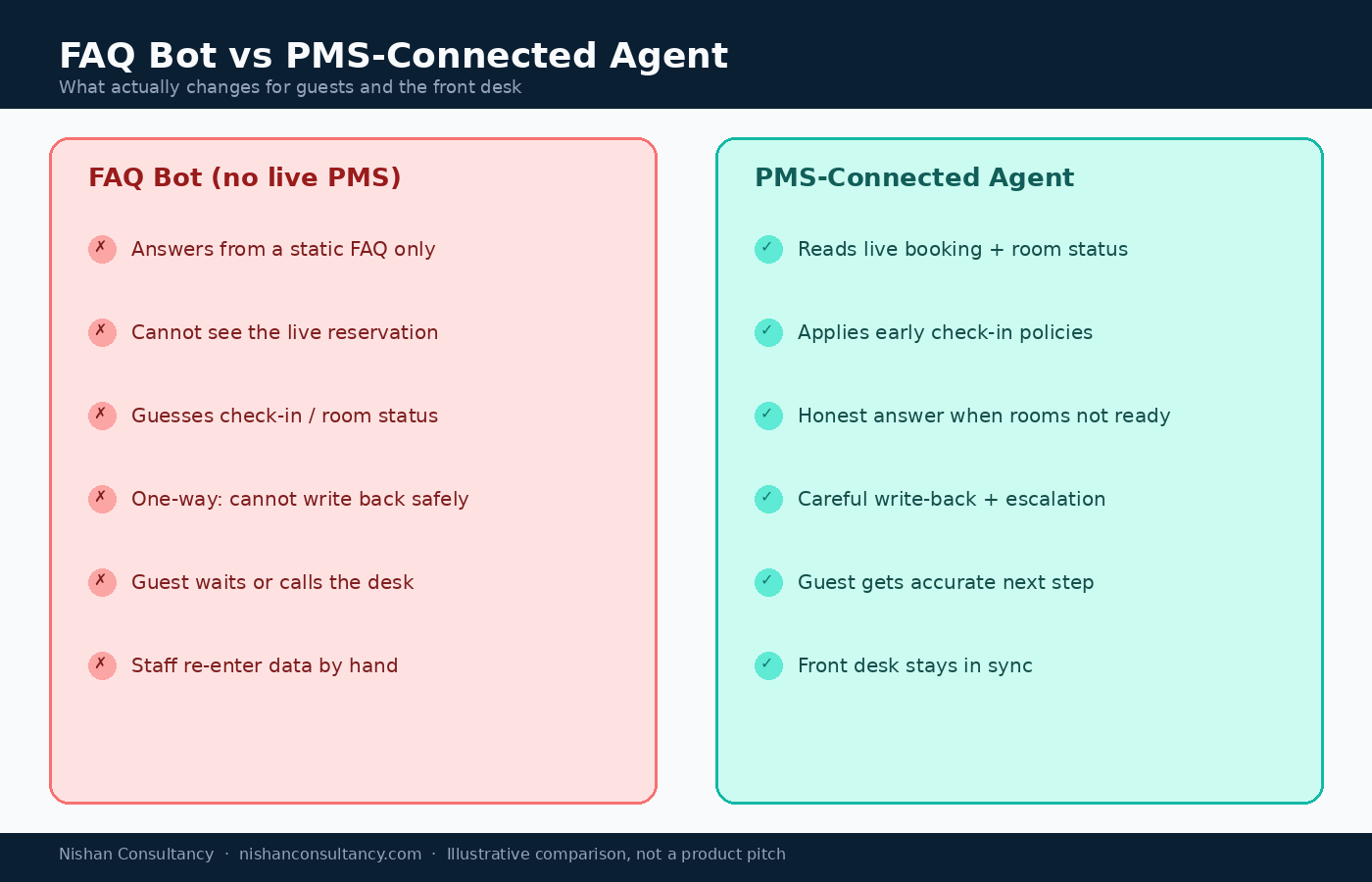
FAQ bot vs PMS-connected agent — illustrative comparison.
Why most hotel AI fails in production
1) No live reservation, rate, or room-status access
If the bot cannot see the live booking, it cannot confirm this guest’s arrival window, this room’s dirty/clean state, or this rate’s early-check-in rule. Guests notice. Trust drops. The desk gets the call anyway — plus a frustrated guest.
2) One-way tools and manual re-entry
Messaging that only reads outbound templates, or captures guest details that never write back to the PMS, creates a second system of truth. Staff re-key registration cards, arrival times, and vehicle details. That is not automation; it is a new inbox with homework.
Akia’s published Mari Jean Hotel case study (a boutique property on Mews) is useful as a vendor case study, not a Nishan client result: their prior platform’s promised two-way integration fell short, so teams manually transferred guest registration data into Mews. Arrival times, vehicle details, and check-in statuses did not sync cleanly. After moving to a two-way Akia–Mews setup, the property reported roughly a 50% reduction in data entry in that vendor write-up. Treat those figures as illustrative vendor commentary until you verify them on your own stack.
3) Polling lag dressed up as “integration”
Hotel Tech Insight’s 2026 PMS integration guide is blunt: marketplace “integrations” range from direct API / webhook updates to XML feeds that poll every 15–30 minutes. Polling looks fine in a slide deck and fails at peak demand — stale rates, late room flips, housekeeping collisions after check-in. The check-in-to-PMS path is called out as especially fragile because it must move identity, room assignment, payment tokens, consents, and in-house status together. If any piece lags, the demo still looks fine while live ops quietly burn hours.
Hospitality Net’s opinion coverage on PMS integrations without pain (data mapping, events, ownership) lands on the same theme operators miss in RFPs: field maps, who owns each record, event-driven updates (not only the first booking), and messy-scenario tests before go-live.
What “live PMS access” actually means
Live access is not “we connected once.” For guest agents, it usually means three layers:
1. Read — reservation identity, dates, rate plan, room type/assignment, guest contact, special requests, and current room / housekeeping status with low latency.
2. Careful write-back — only the fields you authorize (notes, arrival ETA, pre-check-in flags, approved early-check-in charges, task tickets). Never let an open-ended model rewrite rates or cancel stays without hard guardrails.
3. Escalation — when policy is ambiguous, inventory is contested, or the guest is upset, route to a human with the full thread and PMS context attached.
If a vendor cannot show those three on your test data — including a mid-stay room move and a denied early check-in — you do not have live access. You have a brochure.
Practical checklist before you buy or build an agent
Use this with any vendor (or internal build) this quarter:
1. Field map in writing — which reservation, guest-profile, room-status, and charge fields sync each direction?
2. Event vs poll — webhooks / direct API, or interval polling? What is the worst-case lag overnight?
3. Early check-in scenario — demo against a live calendar conflict and a cleaning window; require an honest denial path.
4. Write-back boundaries — list every field the agent may change; default deny everything else.
5. Error surfacing — when the PMS link drops at 2 a.m., who is alerted, and how do guests get human help?
6. Audit trail — can you replay what the agent read and wrote for a dispute or GDPR request?
7. PMS realities — Opera Cloud, Cloudbeds, and Mews (and others) differ on APIs, marketplace depth, and write permissions. Ask for your PMS, not a generic slide.
Start with one workflow this quarter
Guestara’s advice for independents matches what we see in practice: start with one workflow, not five. A sensible first slice:
After-hours FAQ that is allowed to answer only from approved content plus
Early / late check-in and arrival-ETA handling backed by live reservation and room status, with clear escalate-to-duty-manager rules.
Run it 30 days. Measure: after-hours tickets handled without desk touch, wrong answers escalated, and minutes of re-keying removed — not vanity “messages automated” counts.
Related distribution pain (brand-intent guests steered to OTAs before they ever chat with your agent) is covered in our piece on brand-search hijacking and direct bookings. Fixing the agent without a trustworthy direct path still leaves money on the table.
How Nishan approaches AI guest agents
At Nishan Consultancy, AI Agent Building sits next to PMS Issues and Workflow Automation on purpose. We design agents around PMS-aware boundaries: what may be read, what may be written, and when a human must own the thread. We prefer boring, testable workflows over “do everything” demos.
Honest caveats: we do not invent client ROI in this article. Case studies on site are illustrative until verified. Outcomes depend on your PMS API quality, data hygiene, staff training, and how tightly you scope the first workflow. There is no guarantee that any agent will cut night calls by a fixed percentage.
If you want a scoped review of whether your Opera / Cloudbeds / Mews stack can support a safe guest agent — or help wiring the first after-hours workflow — request a demo or contact us. Phone (+1) 778-538-0702 · email info@nishanconsultancy.com.
FAQ
Is a website chatbot enough for after-hours guests?
It is enough for static facts (Wi‑Fi, parking address, pool hours) if those pages stay accurate. It is not enough for early check-in, room readiness, or folio questions that need live PMS data.
Do we need a full custom agent stack?
Usually no for a single independent property. Guestara’s trade commentary argues most independents lack the unified data and engineering budget enterprise stacks assume.
What is the fastest red-flag in a vendor demo?
Scripted answers that never open your test reservation, or “integration” that only syncs the initial booking and ignores later room moves and modifications (a failure mode Hotel Tech Insight documents for check-in flows).
Will live access mean the AI can change anything in the PMS?
It should not. Good designs use least-privilege write scopes, confirmation steps for money-moving actions, and mandatory escalation for cancellations, compensations, and safety issues.
Sources (public / trade)
1. Guestara — AI Agent for Hotels: What Actually Works in 2026 (FAQ vs agent; independent-hotel data/API gaps; start with one workflow; Phocuswright ~60% agentic AI experimentation as reported there).
2. Jurny Blog — Why Most PMS AI Is Failing STR Operators (FAQ bolt-ons vs bidirectional live reservation access; early check-in calendar example).
3. Hospitality Net — opinion on PMS integration requirements (data mapping, events, ownership; messy-scenario testing).
4. Hotel Tech Insight — Hotel PMS Integrations 2026 (polling vs real-time; check-in sync failure modes).
5. Akia — Mari Jean Hotel case study (vendor illustration of serverside re-entry pain when messaging is not two-way with Mews).
Published for Nishan Consultancy · Kamloops BC · Hotel PMS, websites, and AI agents for independent hotels.
Why Hotel AI Guest Agents Fail Without Live PMS Access
It is 2:00 a.m. A guest messages: Landing at 7 — can we check in early?
A FAQ bot replies from a static page: “Check-in is at 3:00 p.m.” Helpful as a brochure. Useless as an answer. It cannot see whether the prior stay is out, whether housekeeping has a window, or whether your property even allows early arrivals that day.
An agent with live PMS access does something different. It looks up the reservation, checks room status and policy rules, then either confirms a realistic time, offers a paid early option your team already defined, or explains honestly why the room will not be ready — and escalates when judgment is required.
That gap — brochure AI versus operational AI — is why so many hotel “AI guest agents” disappoint. The model is rarely the problem. The missing piece is usually bidirectional, real-time connection to the property management system (Opera Cloud, Cloudbeds, Mews, and peers).
Chatbot vs agent (plain definitions)
Trade commentary uses these words loosely, so pin them down:
A chatbot / FAQ bot responds. It searches a knowledge base or canned answers. It does not take action in your systems of record.
An AI agent reasons across steps and uses tools: read a reservation, apply a policy, update a note or task, message the guest, and hand off to a human when confidence is low.
Guestara’s May 2026 guidance for independent hotels draws the same line: a Wi‑Fi-password bot is a traditional AI tool; an agent that checks the PMS, issues a digital key, and updates the task board is doing work, not only talking. That article also reports Phocuswright research that roughly 60% of travel businesses are experimenting with or scaling agentic AI — industry research cited there, not a Nishan measurement.
Jurny’s operator-facing write-up on PMS AI makes the buyer question sharper: can the AI do something, or can it only answer questions? If the demo is a chat window over a static FAQ, you are paying for theater.
FAQ bot vs PMS-connected agent — illustrative comparison.
Why most hotel AI fails in production
1) No live reservation, rate, or room-status access
If the bot cannot see the live booking, it cannot confirm this guest’s arrival window, this room’s dirty/clean state, or this rate’s early-check-in rule. Guests notice. Trust drops. The desk gets the call anyway — plus a frustrated guest.
2) One-way tools and manual re-entry
Messaging that only reads outbound templates, or captures guest details that never write back to the PMS, creates a second system of truth. Staff re-key registration cards, arrival times, and vehicle details. That is not automation; it is a new inbox with homework.
Akia’s published Mari Jean Hotel case study (a boutique property on Mews) is useful as a vendor case study, not a Nishan client result: their prior platform’s promised two-way integration fell short, so teams manually transferred guest registration data into Mews. Arrival times, vehicle details, and check-in statuses did not sync cleanly. After moving to a two-way Akia–Mews setup, the property reported roughly a 50% reduction in data entry in that vendor write-up. Treat those figures as illustrative vendor commentary until you verify them on your own stack.
3) Polling lag dressed up as “integration”
Hotel Tech Insight’s 2026 PMS integration guide is blunt: marketplace “integrations” range from direct API / webhook updates to XML feeds that poll every 15–30 minutes. Polling looks fine in a slide deck and fails at peak demand — stale rates, late room flips, housekeeping collisions after check-in. The check-in-to-PMS path is called out as especially fragile because it must move identity, room assignment, payment tokens, consents, and in-house status together. If any piece lags, the demo still looks fine while live ops quietly burn hours.
Hospitality Net’s opinion coverage on PMS integrations without pain (data mapping, events, ownership) lands on the same theme operators miss in RFPs: field maps, who owns each record, event-driven updates (not only the first booking), and messy-scenario tests before go-live.
What “live PMS access” actually means
Live access is not “we connected once.” For guest agents, it usually means three layers:
1. Read — reservation identity, dates, rate plan, room type/assignment, guest contact, special requests, and current room / housekeeping status with low latency.
2. Careful write-back — only the fields you authorize (notes, arrival ETA, pre-check-in flags, approved early-check-in charges, task tickets). Never let an open-ended model rewrite rates or cancel stays without hard guardrails.
3. Escalation — when policy is ambiguous, inventory is contested, or the guest is upset, route to a human with the full thread and PMS context attached.
If a vendor cannot show those three on your test data — including a mid-stay room move and a denied early check-in — you do not have live access. You have a brochure.
Practical checklist before you buy or build an agent
Use this with any vendor (or internal build) this quarter:
1. Field map in writing — which reservation, guest-profile, room-status, and charge fields sync each direction?
2. Event vs poll — webhooks / direct API, or interval polling? What is the worst-case lag overnight?
3. Early check-in scenario — demo against a live calendar conflict and a cleaning window; require an honest denial path.
4. Write-back boundaries — list every field the agent may change; default deny everything else.
5. Error surfacing — when the PMS link drops at 2 a.m., who is alerted, and how do guests get human help?
6. Audit trail — can you replay what the agent read and wrote for a dispute or GDPR request?
7. PMS realities — Opera Cloud, Cloudbeds, and Mews (and others) differ on APIs, marketplace depth, and write permissions. Ask for your PMS, not a generic slide.
Start with one workflow this quarter
Guestara’s advice for independents matches what we see in practice: start with one workflow, not five. A sensible first slice:
After-hours FAQ that is allowed to answer only from approved content plus
Early / late check-in and arrival-ETA handling backed by live reservation and room status, with clear escalate-to-duty-manager rules.
Run it 30 days. Measure: after-hours tickets handled without desk touch, wrong answers escalated, and minutes of re-keying removed — not vanity “messages automated” counts.
Related distribution pain (brand-intent guests steered to OTAs before they ever chat with your agent) is covered in our piece on brand-search hijacking and direct bookings. Fixing the agent without a trustworthy direct path still leaves money on the table.
How Nishan approaches AI guest agents
At Nishan Consultancy, AI Agent Building sits next to PMS Issues and Workflow Automation on purpose. We design agents around PMS-aware boundaries: what may be read, what may be written, and when a human must own the thread. We prefer boring, testable workflows over “do everything” demos.
Honest caveats: we do not invent client ROI in this article. Case studies on site are illustrative until verified. Outcomes depend on your PMS API quality, data hygiene, staff training, and how tightly you scope the first workflow. There is no guarantee that any agent will cut night calls by a fixed percentage.
If you want a scoped review of whether your Opera / Cloudbeds / Mews stack can support a safe guest agent — or help wiring the first after-hours workflow — request a demo or contact us. Phone (+1) 778-538-0702 · email info@nishanconsultancy.com.
FAQ
Is a website chatbot enough for after-hours guests?
It is enough for static facts (Wi‑Fi, parking address, pool hours) if those pages stay accurate. It is not enough for early check-in, room readiness, or folio questions that need live PMS data.
Do we need a full custom agent stack?
Usually no for a single independent property. Guestara’s trade commentary argues most independents lack the unified data and engineering budget enterprise stacks assume.
What is the fastest red-flag in a vendor demo?
Scripted answers that never open your test reservation, or “integration” that only syncs the initial booking and ignores later room moves and modifications (a failure mode Hotel Tech Insight documents for check-in flows).
Will live access mean the AI can change anything in the PMS?
It should not. Good designs use least-privilege write scopes, confirmation steps for money-moving actions, and mandatory escalation for cancellations, compensations, and safety issues.
Sources (public / trade)
1. Guestara — AI Agent for Hotels: What Actually Works in 2026 (FAQ vs agent; independent-hotel data/API gaps; start with one workflow; Phocuswright ~60% agentic AI experimentation as reported there).
2. Jurny Blog — Why Most PMS AI Is Failing STR Operators (FAQ bolt-ons vs bidirectional live reservation access; early check-in calendar example).
3. Hospitality Net — opinion on PMS integration requirements (data mapping, events, ownership; messy-scenario testing).
4. Hotel Tech Insight — Hotel PMS Integrations 2026 (polling vs real-time; check-in sync failure modes).
5. Akia — Mari Jean Hotel case study (vendor illustration of serverside re-entry pain when messaging is not two-way with Mews).
Published for Nishan Consultancy · Kamloops BC · Hotel PMS, websites, and AI agents for independent hotels.
1. Field map in writing — which reservation, guest-profile, room-status, and charge fields sync each direction?
2. Event vs poll — webhooks / direct API, or interval polling? What is the worst-case lag overnight?
3. Early check-in scenario — demo against a live calendar conflict and a cleaning window; require an honest denial path.
4. Write-back boundaries — list every field the agent may change; default deny everything else.
5. Error surfacing — when the PMS link drops at 2 a.m., who is alerted, and how do guests get human help?
6. Audit trail — can you replay what the agent read and wrote for a dispute or GDPR request?
7. PMS realities — Opera Cloud, Cloudbeds, and Mews (and others) differ on APIs, marketplace depth, and write permissions. Ask for your PMS, not a generic slide.
Start with one workflow this quarter
Guestara’s advice for independents matches what we see in practice: start with one workflow, not five. A sensible first slice:
After-hours FAQ that is allowed to answer only from approved content plus
Early / late check-in and arrival-ETA handling backed by live reservation and room status, with clear escalate-to-duty-manager rules.
Run it 30 days. Measure: after-hours tickets handled without desk touch, wrong answers escalated, and minutes of re-keying removed — not vanity “messages automated” counts.
Related distribution pain (brand-intent guests steered to OTAs before they ever chat with your agent) is covered in our piece on brand-search hijacking and direct bookings. Fixing the agent without a trustworthy direct path still leaves money on the table.
How Nishan approaches AI guest agents
At Nishan Consultancy, AI Agent Building sits next to PMS Issues and Workflow Automation on purpose. We design agents around PMS-aware boundaries: what may be read, what may be written, and when a human must own the thread. We prefer boring, testable workflows over “do everything” demos.
Honest caveats: we do not invent client ROI in this article. Case studies on site are illustrative until verified. Outcomes depend on your PMS API quality, data hygiene, staff training, and how tightly you scope the first workflow. There is no guarantee that any agent will cut night calls by a fixed percentage.
If you want a scoped review of whether your Opera / Cloudbeds / Mews stack can support a safe guest agent — or help wiring the first after-hours workflow — request a demo or contact us. Phone (+1) 778-538-0702 · email info@nishanconsultancy.com.
FAQ
Is a website chatbot enough for after-hours guests?
It is enough for static facts (Wi‑Fi, parking address, pool hours) if those pages stay accurate. It is not enough for early check-in, room readiness, or folio questions that need live PMS data.
Do we need a full custom agent stack?
Usually no for a single independent property. Guestara’s trade commentary argues most independents lack the unified data and engineering budget enterprise stacks assume.
What is the fastest red-flag in a vendor demo?
Scripted answers that never open your test reservation, or “integration” that only syncs the initial booking and ignores later room moves and modifications (a failure mode Hotel Tech Insight documents for check-in flows).
Will live access mean the AI can change anything in the PMS?
It should not. Good designs use least-privilege write scopes, confirmation steps for money-moving actions, and mandatory escalation for cancellations, compensations, and safety issues.
Sources (public / trade)
1. Guestara — AI Agent for Hotels: What Actually Works in 2026 (FAQ vs agent; independent-hotel data/API gaps; start with one workflow; Phocuswright ~60% agentic AI experimentation as reported there).
2. Jurny Blog — Why Most PMS AI Is Failing STR Operators (FAQ bolt-ons vs bidirectional live reservation access; early check-in calendar example).
3. Hospitality Net — opinion on PMS integration requirements (data mapping, events, ownership; messy-scenario testing).
4. Hotel Tech Insight — Hotel PMS Integrations 2026 (polling vs real-time; check-in sync failure modes).
5. Akia — Mari Jean Hotel case study (vendor illustration of serverside re-entry pain when messaging is not two-way with Mews).
Published for Nishan Consultancy · Kamloops BC · Hotel PMS, websites, and AI agents for independent hotels.
Why Hotel AI Guest Agents Fail Without Live PMS Access
It is 2:00 a.m. A guest messages: Landing at 7 — can we check in early?
A FAQ bot replies from a static page: “Check-in is at 3:00 p.m.” Helpful as a brochure. Useless as an answer. It cannot see whether the prior stay is out, whether housekeeping has a window, or whether your property even allows early arrivals that day.
An agent with live PMS access does something different. It looks up the reservation, checks room status and policy rules, then either confirms a realistic time, offers a paid early option your team already defined, or explains honestly why the room will not be ready — and escalates when judgment is required.
That gap — brochure AI versus operational AI — is why so many hotel “AI guest agents” disappoint. The model is rarely the problem. The missing piece is usually bidirectional, real-time connection to the property management system (Opera Cloud, Cloudbeds, Mews, and peers).
Chatbot vs agent (plain definitions)
Trade commentary uses these words loosely, so pin them down:
A chatbot / FAQ bot responds. It searches a knowledge base or canned answers. It does not take action in your systems of record.
An AI agent reasons across steps and uses tools: read a reservation, apply a policy, update a note or task, message the guest, and hand off to a human when confidence is low.
Guestara’s May 2026 guidance for independent hotels draws the same line: a Wi‑Fi-password bot is a traditional AI tool; an agent that checks the PMS, issues a digital key, and updates the task board is doing work, not only talking. That article also reports Phocuswright research that roughly 60% of travel businesses are experimenting with or scaling agentic AI — industry research cited there, not a Nishan measurement.
Jurny’s operator-facing write-up on PMS AI makes the buyer question sharper: can the AI do something, or can it only answer questions? If the demo is a chat window over a static FAQ, you are paying for theater.
FAQ bot vs PMS-connected agent — illustrative comparison.
Why most hotel AI fails in production
1) No live reservation, rate, or room-status access
If the bot cannot see the live booking, it cannot confirm this guest’s arrival window, this room’s dirty/clean state, or this rate’s early-check-in rule. Guests notice. Trust drops. The desk gets the call anyway — plus a frustrated guest.
2) One-way tools and manual re-entry
Messaging that only reads outbound templates, or captures guest details that never write back to the PMS, creates a second system of truth. Staff re-key registration cards, arrival times, and vehicle details. That is not automation; it is a new inbox with homework.
Akia’s published Mari Jean Hotel case study (a boutique property on Mews) is useful as a vendor case study, not a Nishan client result: their prior platform’s promised two-way integration fell short, so teams manually transferred guest registration data into Mews. Arrival times, vehicle details, and check-in statuses did not sync cleanly. After moving to a two-way Akia–Mews setup, the property reported roughly a 50% reduction in data entry in that vendor write-up. Treat those figures as illustrative vendor commentary until you verify them on your own stack.
3) Polling lag dressed up as “integration”
Hotel Tech Insight’s 2026 PMS integration guide is blunt: marketplace “integrations” range from direct API / webhook updates to XML feeds that poll every 15–30 minutes. Polling looks fine in a slide deck and fails at peak demand — stale rates, late room flips, housekeeping collisions after check-in. The check-in-to-PMS path is called out as especially fragile because it must move identity, room assignment, payment tokens, consents, and in-house status together. If any piece lags, the demo still looks fine while live ops quietly burn hours.
Hospitality Net’s opinion coverage on PMS integrations without pain (data mapping, events, ownership) lands on the same theme operators miss in RFPs: field maps, who owns each record, event-driven updates (not only the first booking), and messy-scenario tests before go-live.
What “live PMS access” actually means
Live access is not “we connected once.” For guest agents, it usually means three layers:
1. Read — reservation identity, dates, rate plan, room type/assignment, guest contact, special requests, and current room / housekeeping status with low latency.
2. Careful write-back — only the fields you authorize (notes, arrival ETA, pre-check-in flags, approved early-check-in charges, task tickets). Never let an open-ended model rewrite rates or cancel stays without hard guardrails.
3. Escalation — when policy is ambiguous, inventory is contested, or the guest is upset, route to a human with the full thread and PMS context attached.
If a vendor cannot show those three on your test data — including a mid-stay room move and a denied early check-in — you do not have live access. You have a brochure.
Practical checklist before you buy or build an agent
Use this with any vendor (or internal build) this quarter:
1. Field map in writing — which reservation, guest-profile, room-status, and charge fields sync each direction?
2. Event vs poll — webhooks / direct API, or interval polling? What is the worst-case lag overnight?
3. Early check-in scenario — demo against a live calendar conflict and a cleaning window; require an honest denial path.
4. Write-back boundaries — list every field the agent may change; default deny everything else.
5. Error surfacing — when the PMS link drops at 2 a.m., who is alerted, and how do guests get human help?
6. Audit trail — can you replay what the agent read and wrote for a dispute or GDPR request?
7. PMS realities — Opera Cloud, Cloudbeds, and Mews (and others) differ on APIs, marketplace depth, and write permissions. Ask for your PMS, not a generic slide.
Start with one workflow this quarter
Guestara’s advice for independents matches what we see in practice: start with one workflow, not five. A sensible first slice:
After-hours FAQ that is allowed to answer only from approved content plus
Early / late check-in and arrival-ETA handling backed by live reservation and room status, with clear escalate-to-duty-manager rules.
Run it 30 days. Measure: after-hours tickets handled without desk touch, wrong answers escalated, and minutes of re-keying removed — not vanity “messages automated” counts.
Related distribution pain (brand-intent guests steered to OTAs before they ever chat with your agent) is covered in our piece on brand-search hijacking and direct bookings. Fixing the agent without a trustworthy direct path still leaves money on the table.
How Nishan approaches AI guest agents
At Nishan Consultancy, AI Agent Building sits next to PMS Issues and Workflow Automation on purpose. We design agents around PMS-aware boundaries: what may be read, what may be written, and when a human must own the thread. We prefer boring, testable workflows over “do everything” demos.
Honest caveats: we do not invent client ROI in this article. Case studies on site are illustrative until verified. Outcomes depend on your PMS API quality, data hygiene, staff training, and how tightly you scope the first workflow. There is no guarantee that any agent will cut night calls by a fixed percentage.
If you want a scoped review of whether your Opera / Cloudbeds / Mews stack can support a safe guest agent — or help wiring the first after-hours workflow — request a demo or contact us. Phone (+1) 778-538-0702 · email info@nishanconsultancy.com.
FAQ
Is a website chatbot enough for after-hours guests?
It is enough for static facts (Wi‑Fi, parking address, pool hours) if those pages stay accurate. It is not enough for early check-in, room readiness, or folio questions that need live PMS data.
Do we need a full custom agent stack?
Usually no for a single independent property. Guestara’s trade commentary argues most independents lack the unified data and engineering budget enterprise stacks assume.
What is the fastest red-flag in a vendor demo?
Scripted answers that never open your test reservation, or “integration” that only syncs the initial booking and ignores later room moves and modifications (a failure mode Hotel Tech Insight documents for check-in flows).
Will live access mean the AI can change anything in the PMS?
It should not. Good designs use least-privilege write scopes, confirmation steps for money-moving actions, and mandatory escalation for cancellations, compensations, and safety issues.
Sources (public / trade)
1. Guestara — AI Agent for Hotels: What Actually Works in 2026 (FAQ vs agent; independent-hotel data/API gaps; start with one workflow; Phocuswright ~60% agentic AI experimentation as reported there).
2. Jurny Blog — Why Most PMS AI Is Failing STR Operators (FAQ bolt-ons vs bidirectional live reservation access; early check-in calendar example).
3. Hospitality Net — opinion on PMS integration requirements (data mapping, events, ownership; messy-scenario testing).
4. Hotel Tech Insight — Hotel PMS Integrations 2026 (polling vs real-time; check-in sync failure modes).
5. Akia — Mari Jean Hotel case study (vendor illustration of serverside re-entry pain when messaging is not two-way with Mews).
Published for Nishan Consultancy · Kamloops BC · Hotel PMS, websites, and AI agents for independent hotels.
1. Read — reservation identity, dates, rate plan, room type/assignment, guest contact, special requests, and current room / housekeeping status with low latency.
2. Careful write-back — only the fields you authorize (notes, arrival ETA, pre-check-in flags, approved early-check-in charges, task tickets). Never let an open-ended model rewrite rates or cancel stays without hard guardrails.
3. Escalation — when policy is ambiguous, inventory is contested, or the guest is upset, route to a human with the full thread and PMS context attached.
If a vendor cannot show those three on your test data — including a mid-stay room move and a denied early check-in — you do not have live access. You have a brochure.
Practical checklist before you buy or build an agent
Use this with any vendor (or internal build) this quarter:
1. Field map in writing — which reservation, guest-profile, room-status, and charge fields sync each direction?
2. Event vs poll — webhooks / direct API, or interval polling? What is the worst-case lag overnight?
3. Early check-in scenario — demo against a live calendar conflict and a cleaning window; require an honest denial path.
4. Write-back boundaries — list every field the agent may change; default deny everything else.
5. Error surfacing — when the PMS link drops at 2 a.m., who is alerted, and how do guests get human help?
6. Audit trail — can you replay what the agent read and wrote for a dispute or GDPR request?
7. PMS realities — Opera Cloud, Cloudbeds, and Mews (and others) differ on APIs, marketplace depth, and write permissions. Ask for your PMS, not a generic slide.
Start with one workflow this quarter
Guestara’s advice for independents matches what we see in practice: start with one workflow, not five. A sensible first slice:
After-hours FAQ that is allowed to answer only from approved content plus
Early / late check-in and arrival-ETA handling backed by live reservation and room status, with clear escalate-to-duty-manager rules.
Run it 30 days. Measure: after-hours tickets handled without desk touch, wrong answers escalated, and minutes of re-keying removed — not vanity “messages automated” counts.
Related distribution pain (brand-intent guests steered to OTAs before they ever chat with your agent) is covered in our piece on brand-search hijacking and direct bookings. Fixing the agent without a trustworthy direct path still leaves money on the table.
How Nishan approaches AI guest agents
At Nishan Consultancy, AI Agent Building sits next to PMS Issues and Workflow Automation on purpose. We design agents around PMS-aware boundaries: what may be read, what may be written, and when a human must own the thread. We prefer boring, testable workflows over “do everything” demos.
Honest caveats: we do not invent client ROI in this article. Case studies on site are illustrative until verified. Outcomes depend on your PMS API quality, data hygiene, staff training, and how tightly you scope the first workflow. There is no guarantee that any agent will cut night calls by a fixed percentage.
If you want a scoped review of whether your Opera / Cloudbeds / Mews stack can support a safe guest agent — or help wiring the first after-hours workflow — request a demo or contact us. Phone (+1) 778-538-0702 · email info@nishanconsultancy.com.
FAQ
Is a website chatbot enough for after-hours guests?
It is enough for static facts (Wi‑Fi, parking address, pool hours) if those pages stay accurate. It is not enough for early check-in, room readiness, or folio questions that need live PMS data.
Do we need a full custom agent stack?
Usually no for a single independent property. Guestara’s trade commentary argues most independents lack the unified data and engineering budget enterprise stacks assume.
What is the fastest red-flag in a vendor demo?
Scripted answers that never open your test reservation, or “integration” that only syncs the initial booking and ignores later room moves and modifications (a failure mode Hotel Tech Insight documents for check-in flows).
Will live access mean the AI can change anything in the PMS?
It should not. Good designs use least-privilege write scopes, confirmation steps for money-moving actions, and mandatory escalation for cancellations, compensations, and safety issues.
Sources (public / trade)
1. Guestara — AI Agent for Hotels: What Actually Works in 2026 (FAQ vs agent; independent-hotel data/API gaps; start with one workflow; Phocuswright ~60% agentic AI experimentation as reported there).
2. Jurny Blog — Why Most PMS AI Is Failing STR Operators (FAQ bolt-ons vs bidirectional live reservation access; early check-in calendar example).
3. Hospitality Net — opinion on PMS integration requirements (data mapping, events, ownership; messy-scenario testing).
4. Hotel Tech Insight — Hotel PMS Integrations 2026 (polling vs real-time; check-in sync failure modes).
5. Akia — Mari Jean Hotel case study (vendor illustration of serverside re-entry pain when messaging is not two-way with Mews).
Published for Nishan Consultancy · Kamloops BC · Hotel PMS, websites, and AI agents for independent hotels.
Why Hotel AI Guest Agents Fail Without Live PMS Access
It is 2:00 a.m. A guest messages: Landing at 7 — can we check in early?
A FAQ bot replies from a static page: “Check-in is at 3:00 p.m.” Helpful as a brochure. Useless as an answer. It cannot see whether the prior stay is out, whether housekeeping has a window, or whether your property even allows early arrivals that day.
An agent with live PMS access does something different. It looks up the reservation, checks room status and policy rules, then either confirms a realistic time, offers a paid early option your team already defined, or explains honestly why the room will not be ready — and escalates when judgment is required.
That gap — brochure AI versus operational AI — is why so many hotel “AI guest agents” disappoint. The model is rarely the problem. The missing piece is usually bidirectional, real-time connection to the property management system (Opera Cloud, Cloudbeds, Mews, and peers).
Chatbot vs agent (plain definitions)
Trade commentary uses these words loosely, so pin them down:
A chatbot / FAQ bot responds. It searches a knowledge base or canned answers. It does not take action in your systems of record.
An AI agent reasons across steps and uses tools: read a reservation, apply a policy, update a note or task, message the guest, and hand off to a human when confidence is low.
Guestara’s May 2026 guidance for independent hotels draws the same line: a Wi‑Fi-password bot is a traditional AI tool; an agent that checks the PMS, issues a digital key, and updates the task board is doing work, not only talking. That article also reports Phocuswright research that roughly 60% of travel businesses are experimenting with or scaling agentic AI — industry research cited there, not a Nishan measurement.
Jurny’s operator-facing write-up on PMS AI makes the buyer question sharper: can the AI do something, or can it only answer questions? If the demo is a chat window over a static FAQ, you are paying for theater.
FAQ bot vs PMS-connected agent — illustrative comparison.
Why most hotel AI fails in production
1) No live reservation, rate, or room-status access
If the bot cannot see the live booking, it cannot confirm this guest’s arrival window, this room’s dirty/clean state, or this rate’s early-check-in rule. Guests notice. Trust drops. The desk gets the call anyway — plus a frustrated guest.
2) One-way tools and manual re-entry
Messaging that only reads outbound templates, or captures guest details that never write back to the PMS, creates a second system of truth. Staff re-key registration cards, arrival times, and vehicle details. That is not automation; it is a new inbox with homework.
Akia’s published Mari Jean Hotel case study (a boutique property on Mews) is useful as a vendor case study, not a Nishan client result: their prior platform’s promised two-way integration fell short, so teams manually transferred guest registration data into Mews. Arrival times, vehicle details, and check-in statuses did not sync cleanly. After moving to a two-way Akia–Mews setup, the property reported roughly a 50% reduction in data entry in that vendor write-up. Treat those figures as illustrative vendor commentary until you verify them on your own stack.
3) Polling lag dressed up as “integration”
Hotel Tech Insight’s 2026 PMS integration guide is blunt: marketplace “integrations” range from direct API / webhook updates to XML feeds that poll every 15–30 minutes. Polling looks fine in a slide deck and fails at peak demand — stale rates, late room flips, housekeeping collisions after check-in. The check-in-to-PMS path is called out as especially fragile because it must move identity, room assignment, payment tokens, consents, and in-house status together. If any piece lags, the demo still looks fine while live ops quietly burn hours.
Hospitality Net’s opinion coverage on PMS integrations without pain (data mapping, events, ownership) lands on the same theme operators miss in RFPs: field maps, who owns each record, event-driven updates (not only the first booking), and messy-scenario tests before go-live.
What “live PMS access” actually means
Live access is not “we connected once.” For guest agents, it usually means three layers:
1. Read — reservation identity, dates, rate plan, room type/assignment, guest contact, special requests, and current room / housekeeping status with low latency.
2. Careful write-back — only the fields you authorize (notes, arrival ETA, pre-check-in flags, approved early-check-in charges, task tickets). Never let an open-ended model rewrite rates or cancel stays without hard guardrails.
3. Escalation — when policy is ambiguous, inventory is contested, or the guest is upset, route to a human with the full thread and PMS context attached.
If a vendor cannot show those three on your test data — including a mid-stay room move and a denied early check-in — you do not have live access. You have a brochure.
Practical checklist before you buy or build an agent
Use this with any vendor (or internal build) this quarter:
1. Field map in writing — which reservation, guest-profile, room-status, and charge fields sync each direction?
2. Event vs poll — webhooks / direct API, or interval polling? What is the worst-case lag overnight?
3. Early check-in scenario — demo against a live calendar conflict and a cleaning window; require an honest denial path.
4. Write-back boundaries — list every field the agent may change; default deny everything else.
5. Error surfacing — when the PMS link drops at 2 a.m., who is alerted, and how do guests get human help?
6. Audit trail — can you replay what the agent read and wrote for a dispute or GDPR request?
7. PMS realities — Opera Cloud, Cloudbeds, and Mews (and others) differ on APIs, marketplace depth, and write permissions. Ask for your PMS, not a generic slide.
Start with one workflow this quarter
Guestara’s advice for independents matches what we see in practice: start with one workflow, not five. A sensible first slice:
After-hours FAQ that is allowed to answer only from approved content plus
Early / late check-in and arrival-ETA handling backed by live reservation and room status, with clear escalate-to-duty-manager rules.
Run it 30 days. Measure: after-hours tickets handled without desk touch, wrong answers escalated, and minutes of re-keying removed — not vanity “messages automated” counts.
Related distribution pain (brand-intent guests steered to OTAs before they ever chat with your agent) is covered in our piece on brand-search hijacking and direct bookings. Fixing the agent without a trustworthy direct path still leaves money on the table.
How Nishan approaches AI guest agents
At Nishan Consultancy, AI Agent Building sits next to PMS Issues and Workflow Automation on purpose. We design agents around PMS-aware boundaries: what may be read, what may be written, and when a human must own the thread. We prefer boring, testable workflows over “do everything” demos.
Honest caveats: we do not invent client ROI in this article. Case studies on site are illustrative until verified. Outcomes depend on your PMS API quality, data hygiene, staff training, and how tightly you scope the first workflow. There is no guarantee that any agent will cut night calls by a fixed percentage.
If you want a scoped review of whether your Opera / Cloudbeds / Mews stack can support a safe guest agent — or help wiring the first after-hours workflow — request a demo or contact us. Phone (+1) 778-538-0702 · email info@nishanconsultancy.com.
FAQ
Is a website chatbot enough for after-hours guests?
It is enough for static facts (Wi‑Fi, parking address, pool hours) if those pages stay accurate. It is not enough for early check-in, room readiness, or folio questions that need live PMS data.
Do we need a full custom agent stack?
Usually no for a single independent property. Guestara’s trade commentary argues most independents lack the unified data and engineering budget enterprise stacks assume.
What is the fastest red-flag in a vendor demo?
Scripted answers that never open your test reservation, or “integration” that only syncs the initial booking and ignores later room moves and modifications (a failure mode Hotel Tech Insight documents for check-in flows).
Will live access mean the AI can change anything in the PMS?
It should not. Good designs use least-privilege write scopes, confirmation steps for money-moving actions, and mandatory escalation for cancellations, compensations, and safety issues.
Sources (public / trade)
1. Guestara — AI Agent for Hotels: What Actually Works in 2026 (FAQ vs agent; independent-hotel data/API gaps; start with one workflow; Phocuswright ~60% agentic AI experimentation as reported there).
2. Jurny Blog — Why Most PMS AI Is Failing STR Operators (FAQ bolt-ons vs bidirectional live reservation access; early check-in calendar example).
3. Hospitality Net — opinion on PMS integration requirements (data mapping, events, ownership; messy-scenario testing).
4. Hotel Tech Insight — Hotel PMS Integrations 2026 (polling vs real-time; check-in sync failure modes).
5. Akia — Mari Jean Hotel case study (vendor illustration of serverside re-entry pain when messaging is not two-way with Mews).
Published for Nishan Consultancy · Kamloops BC · Hotel PMS, websites, and AI agents for independent hotels.
A chatbot / FAQ bot responds. It searches a knowledge base or canned answers. It does not take action in your systems of record.
An AI agent reasons across steps and uses tools: read a reservation, apply a policy, update a note or task, message the guest, and hand off to a human when confidence is low.
Guestara’s May 2026 guidance for independent hotels draws the same line: a Wi‑Fi-password bot is a traditional AI tool; an agent that checks the PMS, issues a digital key, and updates the task board is doing work, not only talking. That article also reports Phocuswright research that roughly 60% of travel businesses are experimenting with or scaling agentic AI — industry research cited there, not a Nishan measurement.
Jurny’s operator-facing write-up on PMS AI makes the buyer question sharper: can the AI do something, or can it only answer questions? If the demo is a chat window over a static FAQ, you are paying for theater.
FAQ bot vs PMS-connected agent — illustrative comparison.
Why most hotel AI fails in production
1) No live reservation, rate, or room-status access
If the bot cannot see the live booking, it cannot confirm this guest’s arrival window, this room’s dirty/clean state, or this rate’s early-check-in rule. Guests notice. Trust drops. The desk gets the call anyway — plus a frustrated guest.
2) One-way tools and manual re-entry
Messaging that only reads outbound templates, or captures guest details that never write back to the PMS, creates a second system of truth. Staff re-key registration cards, arrival times, and vehicle details. That is not automation; it is a new inbox with homework.
Akia’s published Mari Jean Hotel case study (a boutique property on Mews) is useful as a vendor case study, not a Nishan client result: their prior platform’s promised two-way integration fell short, so teams manually transferred guest registration data into Mews. Arrival times, vehicle details, and check-in statuses did not sync cleanly. After moving to a two-way Akia–Mews setup, the property reported roughly a 50% reduction in data entry in that vendor write-up. Treat those figures as illustrative vendor commentary until you verify them on your own stack.
3) Polling lag dressed up as “integration”
Hotel Tech Insight’s 2026 PMS integration guide is blunt: marketplace “integrations” range from direct API / webhook updates to XML feeds that poll every 15–30 minutes. Polling looks fine in a slide deck and fails at peak demand — stale rates, late room flips, housekeeping collisions after check-in. The check-in-to-PMS path is called out as especially fragile because it must move identity, room assignment, payment tokens, consents, and in-house status together. If any piece lags, the demo still looks fine while live ops quietly burn hours.
Hospitality Net’s opinion coverage on PMS integrations without pain (data mapping, events, ownership) lands on the same theme operators miss in RFPs: field maps, who owns each record, event-driven updates (not only the first booking), and messy-scenario tests before go-live.
What “live PMS access” actually means
Live access is not “we connected once.” For guest agents, it usually means three layers:
1. Read — reservation identity, dates, rate plan, room type/assignment, guest contact, special requests, and current room / housekeeping status with low latency.
2. Careful write-back — only the fields you authorize (notes, arrival ETA, pre-check-in flags, approved early-check-in charges, task tickets). Never let an open-ended model rewrite rates or cancel stays without hard guardrails.
3. Escalation — when policy is ambiguous, inventory is contested, or the guest is upset, route to a human with the full thread and PMS context attached.
If a vendor cannot show those three on your test data — including a mid-stay room move and a denied early check-in — you do not have live access. You have a brochure.
Practical checklist before you buy or build an agent
Use this with any vendor (or internal build) this quarter:
1. Field map in writing — which reservation, guest-profile, room-status, and charge fields sync each direction?
2. Event vs poll — webhooks / direct API, or interval polling? What is the worst-case lag overnight?
3. Early check-in scenario — demo against a live calendar conflict and a cleaning window; require an honest denial path.
4. Write-back boundaries — list every field the agent may change; default deny everything else.
5. Error surfacing — when the PMS link drops at 2 a.m., who is alerted, and how do guests get human help?
6. Audit trail — can you replay what the agent read and wrote for a dispute or GDPR request?
7. PMS realities — Opera Cloud, Cloudbeds, and Mews (and others) differ on APIs, marketplace depth, and write permissions. Ask for your PMS, not a generic slide.
Start with one workflow this quarter
Guestara’s advice for independents matches what we see in practice: start with one workflow, not five. A sensible first slice:
After-hours FAQ that is allowed to answer only from approved content plus
Early / late check-in and arrival-ETA handling backed by live reservation and room status, with clear escalate-to-duty-manager rules.
Run it 30 days. Measure: after-hours tickets handled without desk touch, wrong answers escalated, and minutes of re-keying removed — not vanity “messages automated” counts.
Related distribution pain (brand-intent guests steered to OTAs before they ever chat with your agent) is covered in our piece on brand-search hijacking and direct bookings. Fixing the agent without a trustworthy direct path still leaves money on the table.
How Nishan approaches AI guest agents
At Nishan Consultancy, AI Agent Building sits next to PMS Issues and Workflow Automation on purpose. We design agents around PMS-aware boundaries: what may be read, what may be written, and when a human must own the thread. We prefer boring, testable workflows over “do everything” demos.
Honest caveats: we do not invent client ROI in this article. Case studies on site are illustrative until verified. Outcomes depend on your PMS API quality, data hygiene, staff training, and how tightly you scope the first workflow. There is no guarantee that any agent will cut night calls by a fixed percentage.
If you want a scoped review of whether your Opera / Cloudbeds / Mews stack can support a safe guest agent — or help wiring the first after-hours workflow — request a demo or contact us. Phone (+1) 778-538-0702 · email info@nishanconsultancy.com.
FAQ
Is a website chatbot enough for after-hours guests?
It is enough for static facts (Wi‑Fi, parking address, pool hours) if those pages stay accurate. It is not enough for early check-in, room readiness, or folio questions that need live PMS data.
Do we need a full custom agent stack?
Usually no for a single independent property. Guestara’s trade commentary argues most independents lack the unified data and engineering budget enterprise stacks assume.
What is the fastest red-flag in a vendor demo?
Scripted answers that never open your test reservation, or “integration” that only syncs the initial booking and ignores later room moves and modifications (a failure mode Hotel Tech Insight documents for check-in flows).
Will live access mean the AI can change anything in the PMS?
It should not. Good designs use least-privilege write scopes, confirmation steps for money-moving actions, and mandatory escalation for cancellations, compensations, and safety issues.
Sources (public / trade)
1. Guestara — AI Agent for Hotels: What Actually Works in 2026 (FAQ vs agent; independent-hotel data/API gaps; start with one workflow; Phocuswright ~60% agentic AI experimentation as reported there).
2. Jurny Blog — Why Most PMS AI Is Failing STR Operators (FAQ bolt-ons vs bidirectional live reservation access; early check-in calendar example).
3. Hospitality Net — opinion on PMS integration requirements (data mapping, events, ownership; messy-scenario testing).
4. Hotel Tech Insight — Hotel PMS Integrations 2026 (polling vs real-time; check-in sync failure modes).
5. Akia — Mari Jean Hotel case study (vendor illustration of serverside re-entry pain when messaging is not two-way with Mews).
Published for Nishan Consultancy · Kamloops BC · Hotel PMS, websites, and AI agents for independent hotels.
Why Hotel AI Guest Agents Fail Without Live PMS Access
It is 2:00 a.m. A guest messages: Landing at 7 — can we check in early?
A FAQ bot replies from a static page: “Check-in is at 3:00 p.m.” Helpful as a brochure. Useless as an answer. It cannot see whether the prior stay is out, whether housekeeping has a window, or whether your property even allows early arrivals that day.
An agent with live PMS access does something different. It looks up the reservation, checks room status and policy rules, then either confirms a realistic time, offers a paid early option your team already defined, or explains honestly why the room will not be ready — and escalates when judgment is required.
That gap — brochure AI versus operational AI — is why so many hotel “AI guest agents” disappoint. The model is rarely the problem. The missing piece is usually bidirectional, real-time connection to the property management system (Opera Cloud, Cloudbeds, Mews, and peers).
Chatbot vs agent (plain definitions)
Trade commentary uses these words loosely, so pin them down:
A chatbot / FAQ bot responds. It searches a knowledge base or canned answers. It does not take action in your systems of record.
An AI agent reasons across steps and uses tools: read a reservation, apply a policy, update a note or task, message the guest, and hand off to a human when confidence is low.
Guestara’s May 2026 guidance for independent hotels draws the same line: a Wi‑Fi-password bot is a traditional AI tool; an agent that checks the PMS, issues a digital key, and updates the task board is doing work, not only talking. That article also reports Phocuswright research that roughly 60% of travel businesses are experimenting with or scaling agentic AI — industry research cited there, not a Nishan measurement.
Jurny’s operator-facing write-up on PMS AI makes the buyer question sharper: can the AI do something, or can it only answer questions? If the demo is a chat window over a static FAQ, you are paying for theater.
FAQ bot vs PMS-connected agent — illustrative comparison.
Why most hotel AI fails in production
1) No live reservation, rate, or room-status access
If the bot cannot see the live booking, it cannot confirm this guest’s arrival window, this room’s dirty/clean state, or this rate’s early-check-in rule. Guests notice. Trust drops. The desk gets the call anyway — plus a frustrated guest.
2) One-way tools and manual re-entry
Messaging that only reads outbound templates, or captures guest details that never write back to the PMS, creates a second system of truth. Staff re-key registration cards, arrival times, and vehicle details. That is not automation; it is a new inbox with homework.
Akia’s published Mari Jean Hotel case study (a boutique property on Mews) is useful as a vendor case study, not a Nishan client result: their prior platform’s promised two-way integration fell short, so teams manually transferred guest registration data into Mews. Arrival times, vehicle details, and check-in statuses did not sync cleanly. After moving to a two-way Akia–Mews setup, the property reported roughly a 50% reduction in data entry in that vendor write-up. Treat those figures as illustrative vendor commentary until you verify them on your own stack.
3) Polling lag dressed up as “integration”
Hotel Tech Insight’s 2026 PMS integration guide is blunt: marketplace “integrations” range from direct API / webhook updates to XML feeds that poll every 15–30 minutes. Polling looks fine in a slide deck and fails at peak demand — stale rates, late room flips, housekeeping collisions after check-in. The check-in-to-PMS path is called out as especially fragile because it must move identity, room assignment, payment tokens, consents, and in-house status together. If any piece lags, the demo still looks fine while live ops quietly burn hours.
Hospitality Net’s opinion coverage on PMS integrations without pain (data mapping, events, ownership) lands on the same theme operators miss in RFPs: field maps, who owns each record, event-driven updates (not only the first booking), and messy-scenario tests before go-live.
What “live PMS access” actually means
Live access is not “we connected once.” For guest agents, it usually means three layers:
1. Read — reservation identity, dates, rate plan, room type/assignment, guest contact, special requests, and current room / housekeeping status with low latency.
2. Careful write-back — only the fields you authorize (notes, arrival ETA, pre-check-in flags, approved early-check-in charges, task tickets). Never let an open-ended model rewrite rates or cancel stays without hard guardrails.
3. Escalation — when policy is ambiguous, inventory is contested, or the guest is upset, route to a human with the full thread and PMS context attached.
If a vendor cannot show those three on your test data — including a mid-stay room move and a denied early check-in — you do not have live access. You have a brochure.
Practical checklist before you buy or build an agent
Use this with any vendor (or internal build) this quarter:
1. Field map in writing — which reservation, guest-profile, room-status, and charge fields sync each direction?
2. Event vs poll — webhooks / direct API, or interval polling? What is the worst-case lag overnight?
3. Early check-in scenario — demo against a live calendar conflict and a cleaning window; require an honest denial path.
4. Write-back boundaries — list every field the agent may change; default deny everything else.
5. Error surfacing — when the PMS link drops at 2 a.m., who is alerted, and how do guests get human help?
6. Audit trail — can you replay what the agent read and wrote for a dispute or GDPR request?
7. PMS realities — Opera Cloud, Cloudbeds, and Mews (and others) differ on APIs, marketplace depth, and write permissions. Ask for your PMS, not a generic slide.
Start with one workflow this quarter
Guestara’s advice for independents matches what we see in practice: start with one workflow, not five. A sensible first slice:
After-hours FAQ that is allowed to answer only from approved content plus
Early / late check-in and arrival-ETA handling backed by live reservation and room status, with clear escalate-to-duty-manager rules.
Run it 30 days. Measure: after-hours tickets handled without desk touch, wrong answers escalated, and minutes of re-keying removed — not vanity “messages automated” counts.
Related distribution pain (brand-intent guests steered to OTAs before they ever chat with your agent) is covered in our piece on brand-search hijacking and direct bookings. Fixing the agent without a trustworthy direct path still leaves money on the table.
How Nishan approaches AI guest agents
At Nishan Consultancy, AI Agent Building sits next to PMS Issues and Workflow Automation on purpose. We design agents around PMS-aware boundaries: what may be read, what may be written, and when a human must own the thread. We prefer boring, testable workflows over “do everything” demos.
Honest caveats: we do not invent client ROI in this article. Case studies on site are illustrative until verified. Outcomes depend on your PMS API quality, data hygiene, staff training, and how tightly you scope the first workflow. There is no guarantee that any agent will cut night calls by a fixed percentage.
If you want a scoped review of whether your Opera / Cloudbeds / Mews stack can support a safe guest agent — or help wiring the first after-hours workflow — request a demo or contact us. Phone (+1) 778-538-0702 · email info@nishanconsultancy.com.
FAQ
Is a website chatbot enough for after-hours guests?
It is enough for static facts (Wi‑Fi, parking address, pool hours) if those pages stay accurate. It is not enough for early check-in, room readiness, or folio questions that need live PMS data.
Do we need a full custom agent stack?
Usually no for a single independent property. Guestara’s trade commentary argues most independents lack the unified data and engineering budget enterprise stacks assume.
What is the fastest red-flag in a vendor demo?
Scripted answers that never open your test reservation, or “integration” that only syncs the initial booking and ignores later room moves and modifications (a failure mode Hotel Tech Insight documents for check-in flows).
Will live access mean the AI can change anything in the PMS?
It should not. Good designs use least-privilege write scopes, confirmation steps for money-moving actions, and mandatory escalation for cancellations, compensations, and safety issues.
Sources (public / trade)
1. Guestara — AI Agent for Hotels: What Actually Works in 2026 (FAQ vs agent; independent-hotel data/API gaps; start with one workflow; Phocuswright ~60% agentic AI experimentation as reported there).
2. Jurny Blog — Why Most PMS AI Is Failing STR Operators (FAQ bolt-ons vs bidirectional live reservation access; early check-in calendar example).
3. Hospitality Net — opinion on PMS integration requirements (data mapping, events, ownership; messy-scenario testing).
4. Hotel Tech Insight — Hotel PMS Integrations 2026 (polling vs real-time; check-in sync failure modes).
5. Akia — Mari Jean Hotel case study (vendor illustration of serverside re-entry pain when messaging is not two-way with Mews).
Published for Nishan Consultancy · Kamloops BC · Hotel PMS, websites, and AI agents for independent hotels.
1. Field map in writing — which reservation, guest-profile, room-status, and charge fields sync each direction?
2. Event vs poll — webhooks / direct API, or interval polling? What is the worst-case lag overnight?
3. Early check-in scenario — demo against a live calendar conflict and a cleaning window; require an honest denial path.
4. Write-back boundaries — list every field the agent may change; default deny everything else.
5. Error surfacing — when the PMS link drops at 2 a.m., who is alerted, and how do guests get human help?
6. Audit trail — can you replay what the agent read and wrote for a dispute or GDPR request?
7. PMS realities — Opera Cloud, Cloudbeds, and Mews (and others) differ on APIs, marketplace depth, and write permissions. Ask for your PMS, not a generic slide.
Start with one workflow this quarter
Guestara’s advice for independents matches what we see in practice: start with one workflow, not five. A sensible first slice:
After-hours FAQ that is allowed to answer only from approved content plus
Early / late check-in and arrival-ETA handling backed by live reservation and room status, with clear escalate-to-duty-manager rules.
Run it 30 days. Measure: after-hours tickets handled without desk touch, wrong answers escalated, and minutes of re-keying removed — not vanity “messages automated” counts.
Related distribution pain (brand-intent guests steered to OTAs before they ever chat with your agent) is covered in our piece on brand-search hijacking and direct bookings. Fixing the agent without a trustworthy direct path still leaves money on the table.
How Nishan approaches AI guest agents
At Nishan Consultancy, AI Agent Building sits next to PMS Issues and Workflow Automation on purpose. We design agents around PMS-aware boundaries: what may be read, what may be written, and when a human must own the thread. We prefer boring, testable workflows over “do everything” demos.
Honest caveats: we do not invent client ROI in this article. Case studies on site are illustrative until verified. Outcomes depend on your PMS API quality, data hygiene, staff training, and how tightly you scope the first workflow. There is no guarantee that any agent will cut night calls by a fixed percentage.
If you want a scoped review of whether your Opera / Cloudbeds / Mews stack can support a safe guest agent — or help wiring the first after-hours workflow — request a demo or contact us. Phone (+1) 778-538-0702 · email info@nishanconsultancy.com.
FAQ
Is a website chatbot enough for after-hours guests?
It is enough for static facts (Wi‑Fi, parking address, pool hours) if those pages stay accurate. It is not enough for early check-in, room readiness, or folio questions that need live PMS data.
Do we need a full custom agent stack?
Usually no for a single independent property. Guestara’s trade commentary argues most independents lack the unified data and engineering budget enterprise stacks assume.
What is the fastest red-flag in a vendor demo?
Scripted answers that never open your test reservation, or “integration” that only syncs the initial booking and ignores later room moves and modifications (a failure mode Hotel Tech Insight documents for check-in flows).
Will live access mean the AI can change anything in the PMS?
It should not. Good designs use least-privilege write scopes, confirmation steps for money-moving actions, and mandatory escalation for cancellations, compensations, and safety issues.
Sources (public / trade)
1. Guestara — AI Agent for Hotels: What Actually Works in 2026 (FAQ vs agent; independent-hotel data/API gaps; start with one workflow; Phocuswright ~60% agentic AI experimentation as reported there).
2. Jurny Blog — Why Most PMS AI Is Failing STR Operators (FAQ bolt-ons vs bidirectional live reservation access; early check-in calendar example).
3. Hospitality Net — opinion on PMS integration requirements (data mapping, events, ownership; messy-scenario testing).
4. Hotel Tech Insight — Hotel PMS Integrations 2026 (polling vs real-time; check-in sync failure modes).
5. Akia — Mari Jean Hotel case study (vendor illustration of serverside re-entry pain when messaging is not two-way with Mews).
Published for Nishan Consultancy · Kamloops BC · Hotel PMS, websites, and AI agents for independent hotels.
A chatbot / FAQ bot responds. It searches a knowledge base or canned answers. It does not take action in your systems of record.
An AI agent reasons across steps and uses tools: read a reservation, apply a policy, update a note or task, message the guest, and hand off to a human when confidence is low.
Guestara’s May 2026 guidance for independent hotels draws the same line: a Wi‑Fi-password bot is a traditional AI tool; an agent that checks the PMS, issues a digital key, and updates the task board is doing work, not only talking. That article also reports Phocuswright research that roughly 60% of travel businesses are experimenting with or scaling agentic AI — industry research cited there, not a Nishan measurement.
Jurny’s operator-facing write-up on PMS AI makes the buyer question sharper: can the AI do something, or can it only answer questions? If the demo is a chat window over a static FAQ, you are paying for theater.
FAQ bot vs PMS-connected agent — illustrative comparison.
Why most hotel AI fails in production
1) No live reservation, rate, or room-status access
If the bot cannot see the live booking, it cannot confirm this guest’s arrival window, this room’s dirty/clean state, or this rate’s early-check-in rule. Guests notice. Trust drops. The desk gets the call anyway — plus a frustrated guest.
2) One-way tools and manual re-entry
Messaging that only reads outbound templates, or captures guest details that never write back to the PMS, creates a second system of truth. Staff re-key registration cards, arrival times, and vehicle details. That is not automation; it is a new inbox with homework.
Akia’s published Mari Jean Hotel case study (a boutique property on Mews) is useful as a vendor case study, not a Nishan client result: their prior platform’s promised two-way integration fell short, so teams manually transferred guest registration data into Mews. Arrival times, vehicle details, and check-in statuses did not sync cleanly. After moving to a two-way Akia–Mews setup, the property reported roughly a 50% reduction in data entry in that vendor write-up. Treat those figures as illustrative vendor commentary until you verify them on your own stack.
3) Polling lag dressed up as “integration”
Hotel Tech Insight’s 2026 PMS integration guide is blunt: marketplace “integrations” range from direct API / webhook updates to XML feeds that poll every 15–30 minutes. Polling looks fine in a slide deck and fails at peak demand — stale rates, late room flips, housekeeping collisions after check-in. The check-in-to-PMS path is called out as especially fragile because it must move identity, room assignment, payment tokens, consents, and in-house status together. If any piece lags, the demo still looks fine while live ops quietly burn hours.
Hospitality Net’s opinion coverage on PMS integrations without pain (data mapping, events, ownership) lands on the same theme operators miss in RFPs: field maps, who owns each record, event-driven updates (not only the first booking), and messy-scenario tests before go-live.
What “live PMS access” actually means
Live access is not “we connected once.” For guest agents, it usually means three layers:
1. Read — reservation identity, dates, rate plan, room type/assignment, guest contact, special requests, and current room / housekeeping status with low latency.
2. Careful write-back — only the fields you authorize (notes, arrival ETA, pre-check-in flags, approved early-check-in charges, task tickets). Never let an open-ended model rewrite rates or cancel stays without hard guardrails.
3. Escalation — when policy is ambiguous, inventory is contested, or the guest is upset, route to a human with the full thread and PMS context attached.
If a vendor cannot show those three on your test data — including a mid-stay room move and a denied early check-in — you do not have live access. You have a brochure.
Practical checklist before you buy or build an agent
Use this with any vendor (or internal build) this quarter:
1. Field map in writing — which reservation, guest-profile, room-status, and charge fields sync each direction?
2. Event vs poll — webhooks / direct API, or interval polling? What is the worst-case lag overnight?
3. Early check-in scenario — demo against a live calendar conflict and a cleaning window; require an honest denial path.
4. Write-back boundaries — list every field the agent may change; default deny everything else.
5. Error surfacing — when the PMS link drops at 2 a.m., who is alerted, and how do guests get human help?
6. Audit trail — can you replay what the agent read and wrote for a dispute or GDPR request?
7. PMS realities — Opera Cloud, Cloudbeds, and Mews (and others) differ on APIs, marketplace depth, and write permissions. Ask for your PMS, not a generic slide.
Start with one workflow this quarter
Guestara’s advice for independents matches what we see in practice: start with one workflow, not five. A sensible first slice:
After-hours FAQ that is allowed to answer only from approved content plus
Early / late check-in and arrival-ETA handling backed by live reservation and room status, with clear escalate-to-duty-manager rules.
Run it 30 days. Measure: after-hours tickets handled without desk touch, wrong answers escalated, and minutes of re-keying removed — not vanity “messages automated” counts.
Related distribution pain (brand-intent guests steered to OTAs before they ever chat with your agent) is covered in our piece on brand-search hijacking and direct bookings. Fixing the agent without a trustworthy direct path still leaves money on the table.
How Nishan approaches AI guest agents
At Nishan Consultancy, AI Agent Building sits next to PMS Issues and Workflow Automation on purpose. We design agents around PMS-aware boundaries: what may be read, what may be written, and when a human must own the thread. We prefer boring, testable workflows over “do everything” demos.
Honest caveats: we do not invent client ROI in this article. Case studies on site are illustrative until verified. Outcomes depend on your PMS API quality, data hygiene, staff training, and how tightly you scope the first workflow. There is no guarantee that any agent will cut night calls by a fixed percentage.
If you want a scoped review of whether your Opera / Cloudbeds / Mews stack can support a safe guest agent — or help wiring the first after-hours workflow — request a demo or contact us. Phone (+1) 778-538-0702 · email info@nishanconsultancy.com.
FAQ
Is a website chatbot enough for after-hours guests?
It is enough for static facts (Wi‑Fi, parking address, pool hours) if those pages stay accurate. It is not enough for early check-in, room readiness, or folio questions that need live PMS data.
Do we need a full custom agent stack?
Usually no for a single independent property. Guestara’s trade commentary argues most independents lack the unified data and engineering budget enterprise stacks assume.
What is the fastest red-flag in a vendor demo?
Scripted answers that never open your test reservation, or “integration” that only syncs the initial booking and ignores later room moves and modifications (a failure mode Hotel Tech Insight documents for check-in flows).
Will live access mean the AI can change anything in the PMS?
It should not. Good designs use least-privilege write scopes, confirmation steps for money-moving actions, and mandatory escalation for cancellations, compensations, and safety issues.
Sources (public / trade)
1. Guestara — AI Agent for Hotels: What Actually Works in 2026 (FAQ vs agent; independent-hotel data/API gaps; start with one workflow; Phocuswright ~60% agentic AI experimentation as reported there).
2. Jurny Blog — Why Most PMS AI Is Failing STR Operators (FAQ bolt-ons vs bidirectional live reservation access; early check-in calendar example).
3. Hospitality Net — opinion on PMS integration requirements (data mapping, events, ownership; messy-scenario testing).
4. Hotel Tech Insight — Hotel PMS Integrations 2026 (polling vs real-time; check-in sync failure modes).
5. Akia — Mari Jean Hotel case study (vendor illustration of serverside re-entry pain when messaging is not two-way with Mews).
Published for Nishan Consultancy · Kamloops BC · Hotel PMS, websites, and AI agents for independent hotels.
Why Hotel AI Guest Agents Fail Without Live PMS Access
It is 2:00 a.m. A guest messages: Landing at 7 — can we check in early?
A FAQ bot replies from a static page: “Check-in is at 3:00 p.m.” Helpful as a brochure. Useless as an answer. It cannot see whether the prior stay is out, whether housekeeping has a window, or whether your property even allows early arrivals that day.
An agent with live PMS access does something different. It looks up the reservation, checks room status and policy rules, then either confirms a realistic time, offers a paid early option your team already defined, or explains honestly why the room will not be ready — and escalates when judgment is required.
That gap — brochure AI versus operational AI — is why so many hotel “AI guest agents” disappoint. The model is rarely the problem. The missing piece is usually bidirectional, real-time connection to the property management system (Opera Cloud, Cloudbeds, Mews, and peers).
Chatbot vs agent (plain definitions)
Trade commentary uses these words loosely, so pin them down:
A chatbot / FAQ bot responds. It searches a knowledge base or canned answers. It does not take action in your systems of record.
An AI agent reasons across steps and uses tools: read a reservation, apply a policy, update a note or task, message the guest, and hand off to a human when confidence is low.
Guestara’s May 2026 guidance for independent hotels draws the same line: a Wi‑Fi-password bot is a traditional AI tool; an agent that checks the PMS, issues a digital key, and updates the task board is doing work, not only talking. That article also reports Phocuswright research that roughly 60% of travel businesses are experimenting with or scaling agentic AI — industry research cited there, not a Nishan measurement.
Jurny’s operator-facing write-up on PMS AI makes the buyer question sharper: can the AI do something, or can it only answer questions? If the demo is a chat window over a static FAQ, you are paying for theater.
FAQ bot vs PMS-connected agent — illustrative comparison.
Why most hotel AI fails in production
1) No live reservation, rate, or room-status access
If the bot cannot see the live booking, it cannot confirm this guest’s arrival window, this room’s dirty/clean state, or this rate’s early-check-in rule. Guests notice. Trust drops. The desk gets the call anyway — plus a frustrated guest.
2) One-way tools and manual re-entry
Messaging that only reads outbound templates, or captures guest details that never write back to the PMS, creates a second system of truth. Staff re-key registration cards, arrival times, and vehicle details. That is not automation; it is a new inbox with homework.
Akia’s published Mari Jean Hotel case study (a boutique property on Mews) is useful as a vendor case study, not a Nishan client result: their prior platform’s promised two-way integration fell short, so teams manually transferred guest registration data into Mews. Arrival times, vehicle details, and check-in statuses did not sync cleanly. After moving to a two-way Akia–Mews setup, the property reported roughly a 50% reduction in data entry in that vendor write-up. Treat those figures as illustrative vendor commentary until you verify them on your own stack.
3) Polling lag dressed up as “integration”
Hotel Tech Insight’s 2026 PMS integration guide is blunt: marketplace “integrations” range from direct API / webhook updates to XML feeds that poll every 15–30 minutes. Polling looks fine in a slide deck and fails at peak demand — stale rates, late room flips, housekeeping collisions after check-in. The check-in-to-PMS path is called out as especially fragile because it must move identity, room assignment, payment tokens, consents, and in-house status together. If any piece lags, the demo still looks fine while live ops quietly burn hours.
Hospitality Net’s opinion coverage on PMS integrations without pain (data mapping, events, ownership) lands on the same theme operators miss in RFPs: field maps, who owns each record, event-driven updates (not only the first booking), and messy-scenario tests before go-live.
What “live PMS access” actually means
Live access is not “we connected once.” For guest agents, it usually means three layers:
1. Read — reservation identity, dates, rate plan, room type/assignment, guest contact, special requests, and current room / housekeeping status with low latency.
2. Careful write-back — only the fields you authorize (notes, arrival ETA, pre-check-in flags, approved early-check-in charges, task tickets). Never let an open-ended model rewrite rates or cancel stays without hard guardrails.
3. Escalation — when policy is ambiguous, inventory is contested, or the guest is upset, route to a human with the full thread and PMS context attached.
If a vendor cannot show those three on your test data — including a mid-stay room move and a denied early check-in — you do not have live access. You have a brochure.
Practical checklist before you buy or build an agent
Use this with any vendor (or internal build) this quarter:
1. Field map in writing — which reservation, guest-profile, room-status, and charge fields sync each direction?
2. Event vs poll — webhooks / direct API, or interval polling? What is the worst-case lag overnight?
3. Early check-in scenario — demo against a live calendar conflict and a cleaning window; require an honest denial path.
4. Write-back boundaries — list every field the agent may change; default deny everything else.
5. Error surfacing — when the PMS link drops at 2 a.m., who is alerted, and how do guests get human help?
6. Audit trail — can you replay what the agent read and wrote for a dispute or GDPR request?
7. PMS realities — Opera Cloud, Cloudbeds, and Mews (and others) differ on APIs, marketplace depth, and write permissions. Ask for your PMS, not a generic slide.
Start with one workflow this quarter
Guestara’s advice for independents matches what we see in practice: start with one workflow, not five. A sensible first slice:
After-hours FAQ that is allowed to answer only from approved content plus
Early / late check-in and arrival-ETA handling backed by live reservation and room status, with clear escalate-to-duty-manager rules.
Run it 30 days. Measure: after-hours tickets handled without desk touch, wrong answers escalated, and minutes of re-keying removed — not vanity “messages automated” counts.
Related distribution pain (brand-intent guests steered to OTAs before they ever chat with your agent) is covered in our piece on brand-search hijacking and direct bookings. Fixing the agent without a trustworthy direct path still leaves money on the table.
How Nishan approaches AI guest agents
At Nishan Consultancy, AI Agent Building sits next to PMS Issues and Workflow Automation on purpose. We design agents around PMS-aware boundaries: what may be read, what may be written, and when a human must own the thread. We prefer boring, testable workflows over “do everything” demos.
Honest caveats: we do not invent client ROI in this article. Case studies on site are illustrative until verified. Outcomes depend on your PMS API quality, data hygiene, staff training, and how tightly you scope the first workflow. There is no guarantee that any agent will cut night calls by a fixed percentage.
If you want a scoped review of whether your Opera / Cloudbeds / Mews stack can support a safe guest agent — or help wiring the first after-hours workflow — request a demo or contact us. Phone (+1) 778-538-0702 · email info@nishanconsultancy.com.
FAQ
Is a website chatbot enough for after-hours guests?
It is enough for static facts (Wi‑Fi, parking address, pool hours) if those pages stay accurate. It is not enough for early check-in, room readiness, or folio questions that need live PMS data.
Do we need a full custom agent stack?
Usually no for a single independent property. Guestara’s trade commentary argues most independents lack the unified data and engineering budget enterprise stacks assume.
What is the fastest red-flag in a vendor demo?
Scripted answers that never open your test reservation, or “integration” that only syncs the initial booking and ignores later room moves and modifications (a failure mode Hotel Tech Insight documents for check-in flows).
Will live access mean the AI can change anything in the PMS?
It should not. Good designs use least-privilege write scopes, confirmation steps for money-moving actions, and mandatory escalation for cancellations, compensations, and safety issues.
Sources (public / trade)
1. Guestara — AI Agent for Hotels: What Actually Works in 2026 (FAQ vs agent; independent-hotel data/API gaps; start with one workflow; Phocuswright ~60% agentic AI experimentation as reported there).
2. Jurny Blog — Why Most PMS AI Is Failing STR Operators (FAQ bolt-ons vs bidirectional live reservation access; early check-in calendar example).
3. Hospitality Net — opinion on PMS integration requirements (data mapping, events, ownership; messy-scenario testing).
4. Hotel Tech Insight — Hotel PMS Integrations 2026 (polling vs real-time; check-in sync failure modes).
5. Akia — Mari Jean Hotel case study (vendor illustration of serverside re-entry pain when messaging is not two-way with Mews).
Published for Nishan Consultancy · Kamloops BC · Hotel PMS, websites, and AI agents for independent hotels.
1. Read — reservation identity, dates, rate plan, room type/assignment, guest contact, special requests, and current room / housekeeping status with low latency.
2. Careful write-back — only the fields you authorize (notes, arrival ETA, pre-check-in flags, approved early-check-in charges, task tickets). Never let an open-ended model rewrite rates or cancel stays without hard guardrails.
3. Escalation — when policy is ambiguous, inventory is contested, or the guest is upset, route to a human with the full thread and PMS context attached.
If a vendor cannot show those three on your test data — including a mid-stay room move and a denied early check-in — you do not have live access. You have a brochure.
Practical checklist before you buy or build an agent
Use this with any vendor (or internal build) this quarter:
1. Field map in writing — which reservation, guest-profile, room-status, and charge fields sync each direction?
2. Event vs poll — webhooks / direct API, or interval polling? What is the worst-case lag overnight?
3. Early check-in scenario — demo against a live calendar conflict and a cleaning window; require an honest denial path.
4. Write-back boundaries — list every field the agent may change; default deny everything else.
5. Error surfacing — when the PMS link drops at 2 a.m., who is alerted, and how do guests get human help?
6. Audit trail — can you replay what the agent read and wrote for a dispute or GDPR request?
7. PMS realities — Opera Cloud, Cloudbeds, and Mews (and others) differ on APIs, marketplace depth, and write permissions. Ask for your PMS, not a generic slide.
Start with one workflow this quarter
Guestara’s advice for independents matches what we see in practice: start with one workflow, not five. A sensible first slice:
After-hours FAQ that is allowed to answer only from approved content plus
Early / late check-in and arrival-ETA handling backed by live reservation and room status, with clear escalate-to-duty-manager rules.
Run it 30 days. Measure: after-hours tickets handled without desk touch, wrong answers escalated, and minutes of re-keying removed — not vanity “messages automated” counts.
Related distribution pain (brand-intent guests steered to OTAs before they ever chat with your agent) is covered in our piece on brand-search hijacking and direct bookings. Fixing the agent without a trustworthy direct path still leaves money on the table.
How Nishan approaches AI guest agents
At Nishan Consultancy, AI Agent Building sits next to PMS Issues and Workflow Automation on purpose. We design agents around PMS-aware boundaries: what may be read, what may be written, and when a human must own the thread. We prefer boring, testable workflows over “do everything” demos.
Honest caveats: we do not invent client ROI in this article. Case studies on site are illustrative until verified. Outcomes depend on your PMS API quality, data hygiene, staff training, and how tightly you scope the first workflow. There is no guarantee that any agent will cut night calls by a fixed percentage.
If you want a scoped review of whether your Opera / Cloudbeds / Mews stack can support a safe guest agent — or help wiring the first after-hours workflow — request a demo or contact us. Phone (+1) 778-538-0702 · email info@nishanconsultancy.com.
FAQ
Is a website chatbot enough for after-hours guests?
It is enough for static facts (Wi‑Fi, parking address, pool hours) if those pages stay accurate. It is not enough for early check-in, room readiness, or folio questions that need live PMS data.
Do we need a full custom agent stack?
Usually no for a single independent property. Guestara’s trade commentary argues most independents lack the unified data and engineering budget enterprise stacks assume.
What is the fastest red-flag in a vendor demo?
Scripted answers that never open your test reservation, or “integration” that only syncs the initial booking and ignores later room moves and modifications (a failure mode Hotel Tech Insight documents for check-in flows).
Will live access mean the AI can change anything in the PMS?
It should not. Good designs use least-privilege write scopes, confirmation steps for money-moving actions, and mandatory escalation for cancellations, compensations, and safety issues.
Sources (public / trade)
1. Guestara — AI Agent for Hotels: What Actually Works in 2026 (FAQ vs agent; independent-hotel data/API gaps; start with one workflow; Phocuswright ~60% agentic AI experimentation as reported there).
2. Jurny Blog — Why Most PMS AI Is Failing STR Operators (FAQ bolt-ons vs bidirectional live reservation access; early check-in calendar example).
3. Hospitality Net — opinion on PMS integration requirements (data mapping, events, ownership; messy-scenario testing).
4. Hotel Tech Insight — Hotel PMS Integrations 2026 (polling vs real-time; check-in sync failure modes).
5. Akia — Mari Jean Hotel case study (vendor illustration of serverside re-entry pain when messaging is not two-way with Mews).
Published for Nishan Consultancy · Kamloops BC · Hotel PMS, websites, and AI agents for independent hotels.
A chatbot / FAQ bot responds. It searches a knowledge base or canned answers. It does not take action in your systems of record.
An AI agent reasons across steps and uses tools: read a reservation, apply a policy, update a note or task, message the guest, and hand off to a human when confidence is low.
Guestara’s May 2026 guidance for independent hotels draws the same line: a Wi‑Fi-password bot is a traditional AI tool; an agent that checks the PMS, issues a digital key, and updates the task board is doing work, not only talking. That article also reports Phocuswright research that roughly 60% of travel businesses are experimenting with or scaling agentic AI — industry research cited there, not a Nishan measurement.
Jurny’s operator-facing write-up on PMS AI makes the buyer question sharper: can the AI do something, or can it only answer questions? If the demo is a chat window over a static FAQ, you are paying for theater.
FAQ bot vs PMS-connected agent — illustrative comparison.
Why most hotel AI fails in production
1) No live reservation, rate, or room-status access
If the bot cannot see the live booking, it cannot confirm this guest’s arrival window, this room’s dirty/clean state, or this rate’s early-check-in rule. Guests notice. Trust drops. The desk gets the call anyway — plus a frustrated guest.
2) One-way tools and manual re-entry
Messaging that only reads outbound templates, or captures guest details that never write back to the PMS, creates a second system of truth. Staff re-key registration cards, arrival times, and vehicle details. That is not automation; it is a new inbox with homework.
Akia’s published Mari Jean Hotel case study (a boutique property on Mews) is useful as a vendor case study, not a Nishan client result: their prior platform’s promised two-way integration fell short, so teams manually transferred guest registration data into Mews. Arrival times, vehicle details, and check-in statuses did not sync cleanly. After moving to a two-way Akia–Mews setup, the property reported roughly a 50% reduction in data entry in that vendor write-up. Treat those figures as illustrative vendor commentary until you verify them on your own stack.
3) Polling lag dressed up as “integration”
Hotel Tech Insight’s 2026 PMS integration guide is blunt: marketplace “integrations” range from direct API / webhook updates to XML feeds that poll every 15–30 minutes. Polling looks fine in a slide deck and fails at peak demand — stale rates, late room flips, housekeeping collisions after check-in. The check-in-to-PMS path is called out as especially fragile because it must move identity, room assignment, payment tokens, consents, and in-house status together. If any piece lags, the demo still looks fine while live ops quietly burn hours.
Hospitality Net’s opinion coverage on PMS integrations without pain (data mapping, events, ownership) lands on the same theme operators miss in RFPs: field maps, who owns each record, event-driven updates (not only the first booking), and messy-scenario tests before go-live.
What “live PMS access” actually means
Live access is not “we connected once.” For guest agents, it usually means three layers:
1. Read — reservation identity, dates, rate plan, room type/assignment, guest contact, special requests, and current room / housekeeping status with low latency.
2. Careful write-back — only the fields you authorize (notes, arrival ETA, pre-check-in flags, approved early-check-in charges, task tickets). Never let an open-ended model rewrite rates or cancel stays without hard guardrails.
3. Escalation — when policy is ambiguous, inventory is contested, or the guest is upset, route to a human with the full thread and PMS context attached.
If a vendor cannot show those three on your test data — including a mid-stay room move and a denied early check-in — you do not have live access. You have a brochure.
Practical checklist before you buy or build an agent
Use this with any vendor (or internal build) this quarter:
1. Field map in writing — which reservation, guest-profile, room-status, and charge fields sync each direction?
2. Event vs poll — webhooks / direct API, or interval polling? What is the worst-case lag overnight?
3. Early check-in scenario — demo against a live calendar conflict and a cleaning window; require an honest denial path.
4. Write-back boundaries — list every field the agent may change; default deny everything else.
5. Error surfacing — when the PMS link drops at 2 a.m., who is alerted, and how do guests get human help?
6. Audit trail — can you replay what the agent read and wrote for a dispute or GDPR request?
7. PMS realities — Opera Cloud, Cloudbeds, and Mews (and others) differ on APIs, marketplace depth, and write permissions. Ask for your PMS, not a generic slide.
Start with one workflow this quarter
Guestara’s advice for independents matches what we see in practice: start with one workflow, not five. A sensible first slice:
After-hours FAQ that is allowed to answer only from approved content plus
Early / late check-in and arrival-ETA handling backed by live reservation and room status, with clear escalate-to-duty-manager rules.
Run it 30 days. Measure: after-hours tickets handled without desk touch, wrong answers escalated, and minutes of re-keying removed — not vanity “messages automated” counts.
Related distribution pain (brand-intent guests steered to OTAs before they ever chat with your agent) is covered in our piece on brand-search hijacking and direct bookings. Fixing the agent without a trustworthy direct path still leaves money on the table.
How Nishan approaches AI guest agents
At Nishan Consultancy, AI Agent Building sits next to PMS Issues and Workflow Automation on purpose. We design agents around PMS-aware boundaries: what may be read, what may be written, and when a human must own the thread. We prefer boring, testable workflows over “do everything” demos.
Honest caveats: we do not invent client ROI in this article. Case studies on site are illustrative until verified. Outcomes depend on your PMS API quality, data hygiene, staff training, and how tightly you scope the first workflow. There is no guarantee that any agent will cut night calls by a fixed percentage.
If you want a scoped review of whether your Opera / Cloudbeds / Mews stack can support a safe guest agent — or help wiring the first after-hours workflow — request a demo or contact us. Phone (+1) 778-538-0702 · email info@nishanconsultancy.com.
FAQ
Is a website chatbot enough for after-hours guests?
It is enough for static facts (Wi‑Fi, parking address, pool hours) if those pages stay accurate. It is not enough for early check-in, room readiness, or folio questions that need live PMS data.
Do we need a full custom agent stack?
Usually no for a single independent property. Guestara’s trade commentary argues most independents lack the unified data and engineering budget enterprise stacks assume.
What is the fastest red-flag in a vendor demo?
Scripted answers that never open your test reservation, or “integration” that only syncs the initial booking and ignores later room moves and modifications (a failure mode Hotel Tech Insight documents for check-in flows).
Will live access mean the AI can change anything in the PMS?
It should not. Good designs use least-privilege write scopes, confirmation steps for money-moving actions, and mandatory escalation for cancellations, compensations, and safety issues.
Sources (public / trade)
1. Guestara — AI Agent for Hotels: What Actually Works in 2026 (FAQ vs agent; independent-hotel data/API gaps; start with one workflow; Phocuswright ~60% agentic AI experimentation as reported there).
2. Jurny Blog — Why Most PMS AI Is Failing STR Operators (FAQ bolt-ons vs bidirectional live reservation access; early check-in calendar example).
3. Hospitality Net — opinion on PMS integration requirements (data mapping, events, ownership; messy-scenario testing).
4. Hotel Tech Insight — Hotel PMS Integrations 2026 (polling vs real-time; check-in sync failure modes).
5. Akia — Mari Jean Hotel case study (vendor illustration of serverside re-entry pain when messaging is not two-way with Mews).
Published for Nishan Consultancy · Kamloops BC · Hotel PMS, websites, and AI agents for independent hotels.
Why Hotel AI Guest Agents Fail Without Live PMS Access
It is 2:00 a.m. A guest messages: Landing at 7 — can we check in early?
A FAQ bot replies from a static page: “Check-in is at 3:00 p.m.” Helpful as a brochure. Useless as an answer. It cannot see whether the prior stay is out, whether housekeeping has a window, or whether your property even allows early arrivals that day.
An agent with live PMS access does something different. It looks up the reservation, checks room status and policy rules, then either confirms a realistic time, offers a paid early option your team already defined, or explains honestly why the room will not be ready — and escalates when judgment is required.
That gap — brochure AI versus operational AI — is why so many hotel “AI guest agents” disappoint. The model is rarely the problem. The missing piece is usually bidirectional, real-time connection to the property management system (Opera Cloud, Cloudbeds, Mews, and peers).
Chatbot vs agent (plain definitions)
Trade commentary uses these words loosely, so pin them down:
A chatbot / FAQ bot responds. It searches a knowledge base or canned answers. It does not take action in your systems of record.
An AI agent reasons across steps and uses tools: read a reservation, apply a policy, update a note or task, message the guest, and hand off to a human when confidence is low.
Guestara’s May 2026 guidance for independent hotels draws the same line: a Wi‑Fi-password bot is a traditional AI tool; an agent that checks the PMS, issues a digital key, and updates the task board is doing work, not only talking. That article also reports Phocuswright research that roughly 60% of travel businesses are experimenting with or scaling agentic AI — industry research cited there, not a Nishan measurement.
Jurny’s operator-facing write-up on PMS AI makes the buyer question sharper: can the AI do something, or can it only answer questions? If the demo is a chat window over a static FAQ, you are paying for theater.
FAQ bot vs PMS-connected agent — illustrative comparison.
Why most hotel AI fails in production
1) No live reservation, rate, or room-status access
If the bot cannot see the live booking, it cannot confirm this guest’s arrival window, this room’s dirty/clean state, or this rate’s early-check-in rule. Guests notice. Trust drops. The desk gets the call anyway — plus a frustrated guest.
2) One-way tools and manual re-entry
Messaging that only reads outbound templates, or captures guest details that never write back to the PMS, creates a second system of truth. Staff re-key registration cards, arrival times, and vehicle details. That is not automation; it is a new inbox with homework.
Akia’s published Mari Jean Hotel case study (a boutique property on Mews) is useful as a vendor case study, not a Nishan client result: their prior platform’s promised two-way integration fell short, so teams manually transferred guest registration data into Mews. Arrival times, vehicle details, and check-in statuses did not sync cleanly. After moving to a two-way Akia–Mews setup, the property reported roughly a 50% reduction in data entry in that vendor write-up. Treat those figures as illustrative vendor commentary until you verify them on your own stack.
3) Polling lag dressed up as “integration”
Hotel Tech Insight’s 2026 PMS integration guide is blunt: marketplace “integrations” range from direct API / webhook updates to XML feeds that poll every 15–30 minutes. Polling looks fine in a slide deck and fails at peak demand — stale rates, late room flips, housekeeping collisions after check-in. The check-in-to-PMS path is called out as especially fragile because it must move identity, room assignment, payment tokens, consents, and in-house status together. If any piece lags, the demo still looks fine while live ops quietly burn hours.
Hospitality Net’s opinion coverage on PMS integrations without pain (data mapping, events, ownership) lands on the same theme operators miss in RFPs: field maps, who owns each record, event-driven updates (not only the first booking), and messy-scenario tests before go-live.
What “live PMS access” actually means
Live access is not “we connected once.” For guest agents, it usually means three layers:
1. Read — reservation identity, dates, rate plan, room type/assignment, guest contact, special requests, and current room / housekeeping status with low latency.
2. Careful write-back — only the fields you authorize (notes, arrival ETA, pre-check-in flags, approved early-check-in charges, task tickets). Never let an open-ended model rewrite rates or cancel stays without hard guardrails.
3. Escalation — when policy is ambiguous, inventory is contested, or the guest is upset, route to a human with the full thread and PMS context attached.
If a vendor cannot show those three on your test data — including a mid-stay room move and a denied early check-in — you do not have live access. You have a brochure.
Practical checklist before you buy or build an agent
Use this with any vendor (or internal build) this quarter:
1. Field map in writing — which reservation, guest-profile, room-status, and charge fields sync each direction?
2. Event vs poll — webhooks / direct API, or interval polling? What is the worst-case lag overnight?
3. Early check-in scenario — demo against a live calendar conflict and a cleaning window; require an honest denial path.
4. Write-back boundaries — list every field the agent may change; default deny everything else.
5. Error surfacing — when the PMS link drops at 2 a.m., who is alerted, and how do guests get human help?
6. Audit trail — can you replay what the agent read and wrote for a dispute or GDPR request?
7. PMS realities — Opera Cloud, Cloudbeds, and Mews (and others) differ on APIs, marketplace depth, and write permissions. Ask for your PMS, not a generic slide.
Start with one workflow this quarter
Guestara’s advice for independents matches what we see in practice: start with one workflow, not five. A sensible first slice:
After-hours FAQ that is allowed to answer only from approved content plus
Early / late check-in and arrival-ETA handling backed by live reservation and room status, with clear escalate-to-duty-manager rules.
Run it 30 days. Measure: after-hours tickets handled without desk touch, wrong answers escalated, and minutes of re-keying removed — not vanity “messages automated” counts.
Related distribution pain (brand-intent guests steered to OTAs before they ever chat with your agent) is covered in our piece on brand-search hijacking and direct bookings. Fixing the agent without a trustworthy direct path still leaves money on the table.
How Nishan approaches AI guest agents
At Nishan Consultancy, AI Agent Building sits next to PMS Issues and Workflow Automation on purpose. We design agents around PMS-aware boundaries: what may be read, what may be written, and when a human must own the thread. We prefer boring, testable workflows over “do everything” demos.
Honest caveats: we do not invent client ROI in this article. Case studies on site are illustrative until verified. Outcomes depend on your PMS API quality, data hygiene, staff training, and how tightly you scope the first workflow. There is no guarantee that any agent will cut night calls by a fixed percentage.
If you want a scoped review of whether your Opera / Cloudbeds / Mews stack can support a safe guest agent — or help wiring the first after-hours workflow — request a demo or contact us. Phone (+1) 778-538-0702 · email info@nishanconsultancy.com.
FAQ
Is a website chatbot enough for after-hours guests?
It is enough for static facts (Wi‑Fi, parking address, pool hours) if those pages stay accurate. It is not enough for early check-in, room readiness, or folio questions that need live PMS data.
Do we need a full custom agent stack?
Usually no for a single independent property. Guestara’s trade commentary argues most independents lack the unified data and engineering budget enterprise stacks assume.
What is the fastest red-flag in a vendor demo?
Scripted answers that never open your test reservation, or “integration” that only syncs the initial booking and ignores later room moves and modifications (a failure mode Hotel Tech Insight documents for check-in flows).
Will live access mean the AI can change anything in the PMS?
It should not. Good designs use least-privilege write scopes, confirmation steps for money-moving actions, and mandatory escalation for cancellations, compensations, and safety issues.
Sources (public / trade)
1. Guestara — AI Agent for Hotels: What Actually Works in 2026 (FAQ vs agent; independent-hotel data/API gaps; start with one workflow; Phocuswright ~60% agentic AI experimentation as reported there).
2. Jurny Blog — Why Most PMS AI Is Failing STR Operators (FAQ bolt-ons vs bidirectional live reservation access; early check-in calendar example).
3. Hospitality Net — opinion on PMS integration requirements (data mapping, events, ownership; messy-scenario testing).
4. Hotel Tech Insight — Hotel PMS Integrations 2026 (polling vs real-time; check-in sync failure modes).
5. Akia — Mari Jean Hotel case study (vendor illustration of serverside re-entry pain when messaging is not two-way with Mews).
Published for Nishan Consultancy · Kamloops BC · Hotel PMS, websites, and AI agents for independent hotels.
1. Field map in writing — which reservation, guest-profile, room-status, and charge fields sync each direction?
2. Event vs poll — webhooks / direct API, or interval polling? What is the worst-case lag overnight?
3. Early check-in scenario — demo against a live calendar conflict and a cleaning window; require an honest denial path.
4. Write-back boundaries — list every field the agent may change; default deny everything else.
5. Error surfacing — when the PMS link drops at 2 a.m., who is alerted, and how do guests get human help?
6. Audit trail — can you replay what the agent read and wrote for a dispute or GDPR request?
7. PMS realities — Opera Cloud, Cloudbeds, and Mews (and others) differ on APIs, marketplace depth, and write permissions. Ask for your PMS, not a generic slide.
Start with one workflow this quarter
Guestara’s advice for independents matches what we see in practice: start with one workflow, not five. A sensible first slice:
After-hours FAQ that is allowed to answer only from approved content plus
Early / late check-in and arrival-ETA handling backed by live reservation and room status, with clear escalate-to-duty-manager rules.
Run it 30 days. Measure: after-hours tickets handled without desk touch, wrong answers escalated, and minutes of re-keying removed — not vanity “messages automated” counts.
Related distribution pain (brand-intent guests steered to OTAs before they ever chat with your agent) is covered in our piece on brand-search hijacking and direct bookings. Fixing the agent without a trustworthy direct path still leaves money on the table.
How Nishan approaches AI guest agents
At Nishan Consultancy, AI Agent Building sits next to PMS Issues and Workflow Automation on purpose. We design agents around PMS-aware boundaries: what may be read, what may be written, and when a human must own the thread. We prefer boring, testable workflows over “do everything” demos.
Honest caveats: we do not invent client ROI in this article. Case studies on site are illustrative until verified. Outcomes depend on your PMS API quality, data hygiene, staff training, and how tightly you scope the first workflow. There is no guarantee that any agent will cut night calls by a fixed percentage.
If you want a scoped review of whether your Opera / Cloudbeds / Mews stack can support a safe guest agent — or help wiring the first after-hours workflow — request a demo or contact us. Phone (+1) 778-538-0702 · email info@nishanconsultancy.com.
FAQ
Is a website chatbot enough for after-hours guests?
It is enough for static facts (Wi‑Fi, parking address, pool hours) if those pages stay accurate. It is not enough for early check-in, room readiness, or folio questions that need live PMS data.
Do we need a full custom agent stack?
Usually no for a single independent property. Guestara’s trade commentary argues most independents lack the unified data and engineering budget enterprise stacks assume.
What is the fastest red-flag in a vendor demo?
Scripted answers that never open your test reservation, or “integration” that only syncs the initial booking and ignores later room moves and modifications (a failure mode Hotel Tech Insight documents for check-in flows).
Will live access mean the AI can change anything in the PMS?
It should not. Good designs use least-privilege write scopes, confirmation steps for money-moving actions, and mandatory escalation for cancellations, compensations, and safety issues.
Sources (public / trade)
1. Guestara — AI Agent for Hotels: What Actually Works in 2026 (FAQ vs agent; independent-hotel data/API gaps; start with one workflow; Phocuswright ~60% agentic AI experimentation as reported there).
2. Jurny Blog — Why Most PMS AI Is Failing STR Operators (FAQ bolt-ons vs bidirectional live reservation access; early check-in calendar example).
3. Hospitality Net — opinion on PMS integration requirements (data mapping, events, ownership; messy-scenario testing).
4. Hotel Tech Insight — Hotel PMS Integrations 2026 (polling vs real-time; check-in sync failure modes).
5. Akia — Mari Jean Hotel case study (vendor illustration of serverside re-entry pain when messaging is not two-way with Mews).
Published for Nishan Consultancy · Kamloops BC · Hotel PMS, websites, and AI agents for independent hotels.
1. Read — reservation identity, dates, rate plan, room type/assignment, guest contact, special requests, and current room / housekeeping status with low latency.
2. Careful write-back — only the fields you authorize (notes, arrival ETA, pre-check-in flags, approved early-check-in charges, task tickets). Never let an open-ended model rewrite rates or cancel stays without hard guardrails.
3. Escalation — when policy is ambiguous, inventory is contested, or the guest is upset, route to a human with the full thread and PMS context attached.
If a vendor cannot show those three on your test data — including a mid-stay room move and a denied early check-in — you do not have live access. You have a brochure.
Practical checklist before you buy or build an agent
Use this with any vendor (or internal build) this quarter:
1. Field map in writing — which reservation, guest-profile, room-status, and charge fields sync each direction?
2. Event vs poll — webhooks / direct API, or interval polling? What is the worst-case lag overnight?
3. Early check-in scenario — demo against a live calendar conflict and a cleaning window; require an honest denial path.
4. Write-back boundaries — list every field the agent may change; default deny everything else.
5. Error surfacing — when the PMS link drops at 2 a.m., who is alerted, and how do guests get human help?
6. Audit trail — can you replay what the agent read and wrote for a dispute or GDPR request?
7. PMS realities — Opera Cloud, Cloudbeds, and Mews (and others) differ on APIs, marketplace depth, and write permissions. Ask for your PMS, not a generic slide.
Start with one workflow this quarter
Guestara’s advice for independents matches what we see in practice: start with one workflow, not five. A sensible first slice:
After-hours FAQ that is allowed to answer only from approved content plus
Early / late check-in and arrival-ETA handling backed by live reservation and room status, with clear escalate-to-duty-manager rules.
Run it 30 days. Measure: after-hours tickets handled without desk touch, wrong answers escalated, and minutes of re-keying removed — not vanity “messages automated” counts.
Related distribution pain (brand-intent guests steered to OTAs before they ever chat with your agent) is covered in our piece on brand-search hijacking and direct bookings. Fixing the agent without a trustworthy direct path still leaves money on the table.
How Nishan approaches AI guest agents
At Nishan Consultancy, AI Agent Building sits next to PMS Issues and Workflow Automation on purpose. We design agents around PMS-aware boundaries: what may be read, what may be written, and when a human must own the thread. We prefer boring, testable workflows over “do everything” demos.
Honest caveats: we do not invent client ROI in this article. Case studies on site are illustrative until verified. Outcomes depend on your PMS API quality, data hygiene, staff training, and how tightly you scope the first workflow. There is no guarantee that any agent will cut night calls by a fixed percentage.
If you want a scoped review of whether your Opera / Cloudbeds / Mews stack can support a safe guest agent — or help wiring the first after-hours workflow — request a demo or contact us. Phone (+1) 778-538-0702 · email info@nishanconsultancy.com.
FAQ
Is a website chatbot enough for after-hours guests?
It is enough for static facts (Wi‑Fi, parking address, pool hours) if those pages stay accurate. It is not enough for early check-in, room readiness, or folio questions that need live PMS data.
Do we need a full custom agent stack?
Usually no for a single independent property. Guestara’s trade commentary argues most independents lack the unified data and engineering budget enterprise stacks assume.
What is the fastest red-flag in a vendor demo?
Scripted answers that never open your test reservation, or “integration” that only syncs the initial booking and ignores later room moves and modifications (a failure mode Hotel Tech Insight documents for check-in flows).
Will live access mean the AI can change anything in the PMS?
It should not. Good designs use least-privilege write scopes, confirmation steps for money-moving actions, and mandatory escalation for cancellations, compensations, and safety issues.
Sources (public / trade)
1. Guestara — AI Agent for Hotels: What Actually Works in 2026 (FAQ vs agent; independent-hotel data/API gaps; start with one workflow; Phocuswright ~60% agentic AI experimentation as reported there).
2. Jurny Blog — Why Most PMS AI Is Failing STR Operators (FAQ bolt-ons vs bidirectional live reservation access; early check-in calendar example).
3. Hospitality Net — opinion on PMS integration requirements (data mapping, events, ownership; messy-scenario testing).
4. Hotel Tech Insight — Hotel PMS Integrations 2026 (polling vs real-time; check-in sync failure modes).
5. Akia — Mari Jean Hotel case study (vendor illustration of serverside re-entry pain when messaging is not two-way with Mews).
Published for Nishan Consultancy · Kamloops BC · Hotel PMS, websites, and AI agents for independent hotels.
A chatbot / FAQ bot responds. It searches a knowledge base or canned answers. It does not take action in your systems of record.
An AI agent reasons across steps and uses tools: read a reservation, apply a policy, update a note or task, message the guest, and hand off to a human when confidence is low.
Guestara’s May 2026 guidance for independent hotels draws the same line: a Wi‑Fi-password bot is a traditional AI tool; an agent that checks the PMS, issues a digital key, and updates the task board is doing work, not only talking. That article also reports Phocuswright research that roughly 60% of travel businesses are experimenting with or scaling agentic AI — industry research cited there, not a Nishan measurement.
Jurny’s operator-facing write-up on PMS AI makes the buyer question sharper: can the AI do something, or can it only answer questions? If the demo is a chat window over a static FAQ, you are paying for theater.
FAQ bot vs PMS-connected agent — illustrative comparison.
Why most hotel AI fails in production
1) No live reservation, rate, or room-status access
If the bot cannot see the live booking, it cannot confirm this guest’s arrival window, this room’s dirty/clean state, or this rate’s early-check-in rule. Guests notice. Trust drops. The desk gets the call anyway — plus a frustrated guest.
2) One-way tools and manual re-entry
Messaging that only reads outbound templates, or captures guest details that never write back to the PMS, creates a second system of truth. Staff re-key registration cards, arrival times, and vehicle details. That is not automation; it is a new inbox with homework.
Akia’s published Mari Jean Hotel case study (a boutique property on Mews) is useful as a vendor case study, not a Nishan client result: their prior platform’s promised two-way integration fell short, so teams manually transferred guest registration data into Mews. Arrival times, vehicle details, and check-in statuses did not sync cleanly. After moving to a two-way Akia–Mews setup, the property reported roughly a 50% reduction in data entry in that vendor write-up. Treat those figures as illustrative vendor commentary until you verify them on your own stack.
3) Polling lag dressed up as “integration”
Hotel Tech Insight’s 2026 PMS integration guide is blunt: marketplace “integrations” range from direct API / webhook updates to XML feeds that poll every 15–30 minutes. Polling looks fine in a slide deck and fails at peak demand — stale rates, late room flips, housekeeping collisions after check-in. The check-in-to-PMS path is called out as especially fragile because it must move identity, room assignment, payment tokens, consents, and in-house status together. If any piece lags, the demo still looks fine while live ops quietly burn hours.
Hospitality Net’s opinion coverage on PMS integrations without pain (data mapping, events, ownership) lands on the same theme operators miss in RFPs: field maps, who owns each record, event-driven updates (not only the first booking), and messy-scenario tests before go-live.
What “live PMS access” actually means
Live access is not “we connected once.” For guest agents, it usually means three layers:
1. Read — reservation identity, dates, rate plan, room type/assignment, guest contact, special requests, and current room / housekeeping status with low latency.
2. Careful write-back — only the fields you authorize (notes, arrival ETA, pre-check-in flags, approved early-check-in charges, task tickets). Never let an open-ended model rewrite rates or cancel stays without hard guardrails.
3. Escalation — when policy is ambiguous, inventory is contested, or the guest is upset, route to a human with the full thread and PMS context attached.
If a vendor cannot show those three on your test data — including a mid-stay room move and a denied early check-in — you do not have live access. You have a brochure.
Practical checklist before you buy or build an agent
Use this with any vendor (or internal build) this quarter:
1. Field map in writing — which reservation, guest-profile, room-status, and charge fields sync each direction?
2. Event vs poll — webhooks / direct API, or interval polling? What is the worst-case lag overnight?
3. Early check-in scenario — demo against a live calendar conflict and a cleaning window; require an honest denial path.
4. Write-back boundaries — list every field the agent may change; default deny everything else.
5. Error surfacing — when the PMS link drops at 2 a.m., who is alerted, and how do guests get human help?
6. Audit trail — can you replay what the agent read and wrote for a dispute or GDPR request?
7. PMS realities — Opera Cloud, Cloudbeds, and Mews (and others) differ on APIs, marketplace depth, and write permissions. Ask for your PMS, not a generic slide.
Start with one workflow this quarter
Guestara’s advice for independents matches what we see in practice: start with one workflow, not five. A sensible first slice:
After-hours FAQ that is allowed to answer only from approved content plus
Early / late check-in and arrival-ETA handling backed by live reservation and room status, with clear escalate-to-duty-manager rules.
Run it 30 days. Measure: after-hours tickets handled without desk touch, wrong answers escalated, and minutes of re-keying removed — not vanity “messages automated” counts.
Related distribution pain (brand-intent guests steered to OTAs before they ever chat with your agent) is covered in our piece on brand-search hijacking and direct bookings. Fixing the agent without a trustworthy direct path still leaves money on the table.
How Nishan approaches AI guest agents
At Nishan Consultancy, AI Agent Building sits next to PMS Issues and Workflow Automation on purpose. We design agents around PMS-aware boundaries: what may be read, what may be written, and when a human must own the thread. We prefer boring, testable workflows over “do everything” demos.
Honest caveats: we do not invent client ROI in this article. Case studies on site are illustrative until verified. Outcomes depend on your PMS API quality, data hygiene, staff training, and how tightly you scope the first workflow. There is no guarantee that any agent will cut night calls by a fixed percentage.
If you want a scoped review of whether your Opera / Cloudbeds / Mews stack can support a safe guest agent — or help wiring the first after-hours workflow — request a demo or contact us. Phone (+1) 778-538-0702 · email info@nishanconsultancy.com.
FAQ
Is a website chatbot enough for after-hours guests?
It is enough for static facts (Wi‑Fi, parking address, pool hours) if those pages stay accurate. It is not enough for early check-in, room readiness, or folio questions that need live PMS data.
Do we need a full custom agent stack?
Usually no for a single independent property. Guestara’s trade commentary argues most independents lack the unified data and engineering budget enterprise stacks assume.
What is the fastest red-flag in a vendor demo?
Scripted answers that never open your test reservation, or “integration” that only syncs the initial booking and ignores later room moves and modifications (a failure mode Hotel Tech Insight documents for check-in flows).
Will live access mean the AI can change anything in the PMS?
It should not. Good designs use least-privilege write scopes, confirmation steps for money-moving actions, and mandatory escalation for cancellations, compensations, and safety issues.
Sources (public / trade)
1. Guestara — AI Agent for Hotels: What Actually Works in 2026 (FAQ vs agent; independent-hotel data/API gaps; start with one workflow; Phocuswright ~60% agentic AI experimentation as reported there).
2. Jurny Blog — Why Most PMS AI Is Failing STR Operators (FAQ bolt-ons vs bidirectional live reservation access; early check-in calendar example).
3. Hospitality Net — opinion on PMS integration requirements (data mapping, events, ownership; messy-scenario testing).
4. Hotel Tech Insight — Hotel PMS Integrations 2026 (polling vs real-time; check-in sync failure modes).
5. Akia — Mari Jean Hotel case study (vendor illustration of serverside re-entry pain when messaging is not two-way with Mews).
Published for Nishan Consultancy · Kamloops BC · Hotel PMS, websites, and AI agents for independent hotels.
Why Hotel AI Guest Agents Fail Without Live PMS Access
It is 2:00 a.m. A guest messages: Landing at 7 — can we check in early?
A FAQ bot replies from a static page: “Check-in is at 3:00 p.m.” Helpful as a brochure. Useless as an answer. It cannot see whether the prior stay is out, whether housekeeping has a window, or whether your property even allows early arrivals that day.
An agent with live PMS access does something different. It looks up the reservation, checks room status and policy rules, then either confirms a realistic time, offers a paid early option your team already defined, or explains honestly why the room will not be ready — and escalates when judgment is required.
That gap — brochure AI versus operational AI — is why so many hotel “AI guest agents” disappoint. The model is rarely the problem. The missing piece is usually bidirectional, real-time connection to the property management system (Opera Cloud, Cloudbeds, Mews, and peers).
Chatbot vs agent (plain definitions)
Trade commentary uses these words loosely, so pin them down:
A chatbot / FAQ bot responds. It searches a knowledge base or canned answers. It does not take action in your systems of record.
An AI agent reasons across steps and uses tools: read a reservation, apply a policy, update a note or task, message the guest, and hand off to a human when confidence is low.
Guestara’s May 2026 guidance for independent hotels draws the same line: a Wi‑Fi-password bot is a traditional AI tool; an agent that checks the PMS, issues a digital key, and updates the task board is doing work, not only talking. That article also reports Phocuswright research that roughly 60% of travel businesses are experimenting with or scaling agentic AI — industry research cited there, not a Nishan measurement.
Jurny’s operator-facing write-up on PMS AI makes the buyer question sharper: can the AI do something, or can it only answer questions? If the demo is a chat window over a static FAQ, you are paying for theater.
FAQ bot vs PMS-connected agent — illustrative comparison.
Why most hotel AI fails in production
1) No live reservation, rate, or room-status access
If the bot cannot see the live booking, it cannot confirm this guest’s arrival window, this room’s dirty/clean state, or this rate’s early-check-in rule. Guests notice. Trust drops. The desk gets the call anyway — plus a frustrated guest.
2) One-way tools and manual re-entry
Messaging that only reads outbound templates, or captures guest details that never write back to the PMS, creates a second system of truth. Staff re-key registration cards, arrival times, and vehicle details. That is not automation; it is a new inbox with homework.
Akia’s published Mari Jean Hotel case study (a boutique property on Mews) is useful as a vendor case study, not a Nishan client result: their prior platform’s promised two-way integration fell short, so teams manually transferred guest registration data into Mews. Arrival times, vehicle details, and check-in statuses did not sync cleanly. After moving to a two-way Akia–Mews setup, the property reported roughly a 50% reduction in data entry in that vendor write-up. Treat those figures as illustrative vendor commentary until you verify them on your own stack.
3) Polling lag dressed up as “integration”
Hotel Tech Insight’s 2026 PMS integration guide is blunt: marketplace “integrations” range from direct API / webhook updates to XML feeds that poll every 15–30 minutes. Polling looks fine in a slide deck and fails at peak demand — stale rates, late room flips, housekeeping collisions after check-in. The check-in-to-PMS path is called out as especially fragile because it must move identity, room assignment, payment tokens, consents, and in-house status together. If any piece lags, the demo still looks fine while live ops quietly burn hours.
Hospitality Net’s opinion coverage on PMS integrations without pain (data mapping, events, ownership) lands on the same theme operators miss in RFPs: field maps, who owns each record, event-driven updates (not only the first booking), and messy-scenario tests before go-live.
What “live PMS access” actually means
Live access is not “we connected once.” For guest agents, it usually means three layers:
1. Read — reservation identity, dates, rate plan, room type/assignment, guest contact, special requests, and current room / housekeeping status with low latency.
2. Careful write-back — only the fields you authorize (notes, arrival ETA, pre-check-in flags, approved early-check-in charges, task tickets). Never let an open-ended model rewrite rates or cancel stays without hard guardrails.
3. Escalation — when policy is ambiguous, inventory is contested, or the guest is upset, route to a human with the full thread and PMS context attached.
If a vendor cannot show those three on your test data — including a mid-stay room move and a denied early check-in — you do not have live access. You have a brochure.
Practical checklist before you buy or build an agent
Use this with any vendor (or internal build) this quarter:
1. Field map in writing — which reservation, guest-profile, room-status, and charge fields sync each direction?
2. Event vs poll — webhooks / direct API, or interval polling? What is the worst-case lag overnight?
3. Early check-in scenario — demo against a live calendar conflict and a cleaning window; require an honest denial path.
4. Write-back boundaries — list every field the agent may change; default deny everything else.
5. Error surfacing — when the PMS link drops at 2 a.m., who is alerted, and how do guests get human help?
6. Audit trail — can you replay what the agent read and wrote for a dispute or GDPR request?
7. PMS realities — Opera Cloud, Cloudbeds, and Mews (and others) differ on APIs, marketplace depth, and write permissions. Ask for your PMS, not a generic slide.
Start with one workflow this quarter
Guestara’s advice for independents matches what we see in practice: start with one workflow, not five. A sensible first slice:
After-hours FAQ that is allowed to answer only from approved content plus
Early / late check-in and arrival-ETA handling backed by live reservation and room status, with clear escalate-to-duty-manager rules.
Run it 30 days. Measure: after-hours tickets handled without desk touch, wrong answers escalated, and minutes of re-keying removed — not vanity “messages automated” counts.
Related distribution pain (brand-intent guests steered to OTAs before they ever chat with your agent) is covered in our piece on brand-search hijacking and direct bookings. Fixing the agent without a trustworthy direct path still leaves money on the table.
How Nishan approaches AI guest agents
At Nishan Consultancy, AI Agent Building sits next to PMS Issues and Workflow Automation on purpose. We design agents around PMS-aware boundaries: what may be read, what may be written, and when a human must own the thread. We prefer boring, testable workflows over “do everything” demos.
Honest caveats: we do not invent client ROI in this article. Case studies on site are illustrative until verified. Outcomes depend on your PMS API quality, data hygiene, staff training, and how tightly you scope the first workflow. There is no guarantee that any agent will cut night calls by a fixed percentage.
If you want a scoped review of whether your Opera / Cloudbeds / Mews stack can support a safe guest agent — or help wiring the first after-hours workflow — request a demo or contact us. Phone (+1) 778-538-0702 · email info@nishanconsultancy.com.
FAQ
Is a website chatbot enough for after-hours guests?
It is enough for static facts (Wi‑Fi, parking address, pool hours) if those pages stay accurate. It is not enough for early check-in, room readiness, or folio questions that need live PMS data.
Do we need a full custom agent stack?
Usually no for a single independent property. Guestara’s trade commentary argues most independents lack the unified data and engineering budget enterprise stacks assume.
What is the fastest red-flag in a vendor demo?
Scripted answers that never open your test reservation, or “integration” that only syncs the initial booking and ignores later room moves and modifications (a failure mode Hotel Tech Insight documents for check-in flows).
Will live access mean the AI can change anything in the PMS?
It should not. Good designs use least-privilege write scopes, confirmation steps for money-moving actions, and mandatory escalation for cancellations, compensations, and safety issues.
Sources (public / trade)
1. Guestara — AI Agent for Hotels: What Actually Works in 2026 (FAQ vs agent; independent-hotel data/API gaps; start with one workflow; Phocuswright ~60% agentic AI experimentation as reported there).
2. Jurny Blog — Why Most PMS AI Is Failing STR Operators (FAQ bolt-ons vs bidirectional live reservation access; early check-in calendar example).
3. Hospitality Net — opinion on PMS integration requirements (data mapping, events, ownership; messy-scenario testing).
4. Hotel Tech Insight — Hotel PMS Integrations 2026 (polling vs real-time; check-in sync failure modes).
5. Akia — Mari Jean Hotel case study (vendor illustration of serverside re-entry pain when messaging is not two-way with Mews).
Published for Nishan Consultancy · Kamloops BC · Hotel PMS, websites, and AI agents for independent hotels.