Independent hotels already know the familiar OTA story: a guest discovers you on Booking.com or Expedia, you pay commission, and you hope they book direct next time. Cloudbeds’ 2026 State of Independent Hotels report puts global independent OTA share at 63.4% versus 36.6% direct—and notes OTA dependence deepened in every key market it studied.
There is a quieter version of the same bleed.
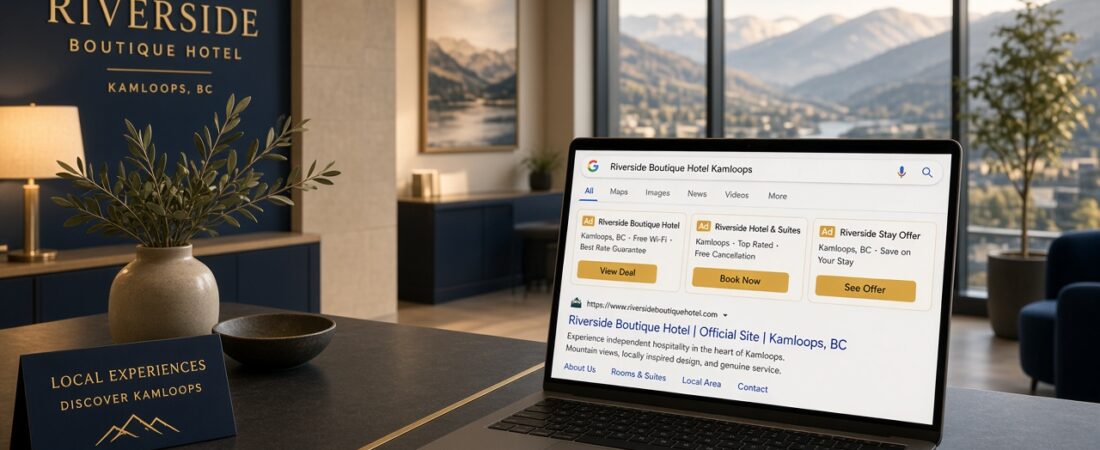
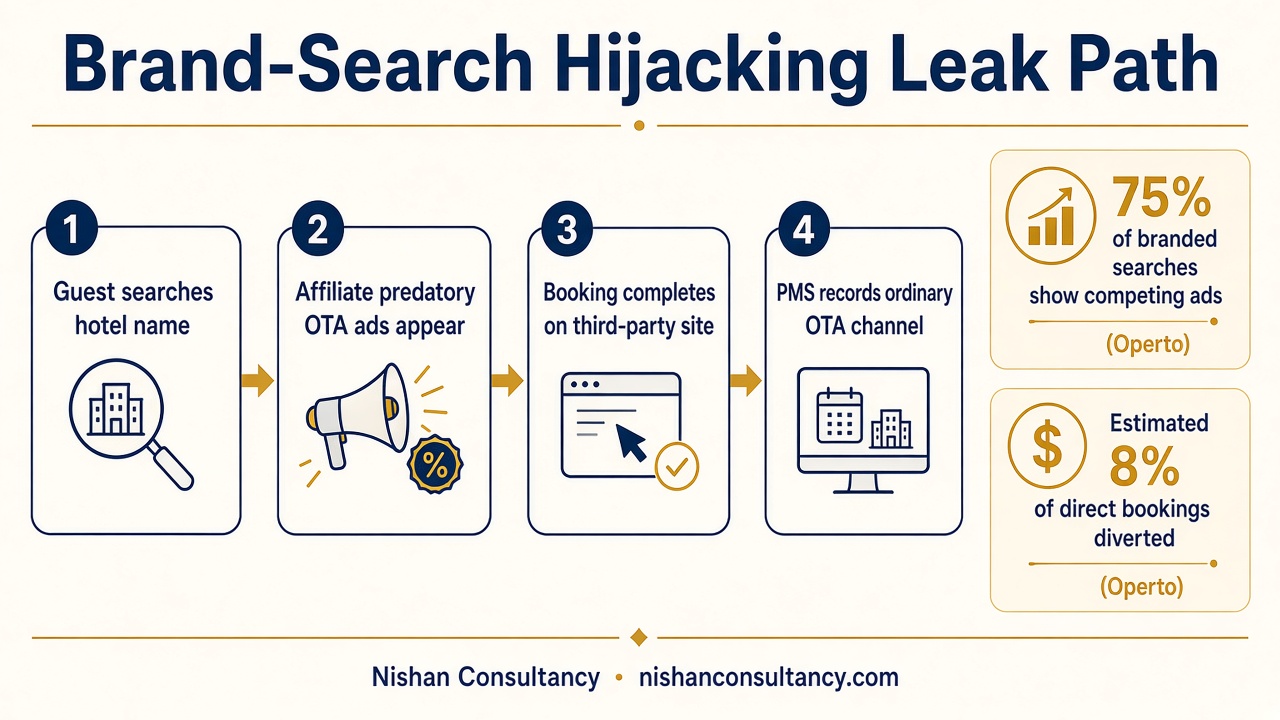
A guest already knows your property and types your hotel name into Google. Before they reach your booking engine, a lookalike sponsored result steers them to an affiliate or “predatory OTA” checkout. The reservation still lands in Opera, Cloudbeds, or Mews—tagged as ordinary third-party business. You pay commission on demand your brand already created, and the channel report never says “hijacked.”
That pattern is brand-search hijacking. It is different from weak website conversion: the guest never reaches the site you fixed.
Why this is not the same as “we need more direct bookings”
Classic direct-booking work focuses on the assets you control: a faster website, clearer rates, mobile checkout, SEO, metasearch, and post-stay win-backs. Those still matter—see our pillars on hotel marketing management and website design & development.
Brand-search hijacking sits one step earlier. Operto’s published research (widely cited in trade coverage in 2026) reports that competing OTA-style ads appear on roughly 75% of branded hotel searches, that the average hotel competes with about nine such advertisers for its own name, and that it estimates about 8% of direct bookings are lost this way. Boutique Hotel News, quoting Operto CEO Tim Major, also described more than 250,000 Google ads across Canada and the United States targeting hotel brand names via affiliate booking sites.
Those figures are vendor research, not a census. Treat them as a reason to measure your property—not as a guaranteed loss rate.
The operational sting is the PMS blind spot. Hospitality Technology, summarizing Operto via MarketScale, noted intercepted bookings still create real reservations that appear as ordinary OTA or third-party business. Teams see “Booking.com” or an affiliate—not “guest searched our exact name.” Brand spend creates demand; the last click—and the guest relationship—gets rented back to you.
The operator problem in plain English
For a 40–120 room independent in Canada, the US, or the EU, three costs stack:
- Commission on demand you already originated — the guest did not need an OTA to discover you; they needed a path to your rate calendar.
- Lost first-party data — masked emails and thinner profiles make repeat marketing harder.
- Misread strategy — if “OTA share” includes hijacked brand intent, you may over-invest in more OTA promotions and under-invest in brand defense and direct path quality.
Cloudbeds also shows independents under margin pressure as OTAs gained share globally. Canada, Argentina, and the United States retain relatively more control than the most OTA-heavy markets—but that is not the same as safe brand search.
HotelTechUpdate’s 2026 distribution analysis keeps the math honest: “direct” is not free. Websites, booking engines, metasearch, and payments all cost money. The goal is not zero OTA. It is stopping unnecessary commission on high-intent brand demand, then comparing fully loaded cost by channel.
A practical 10-day audit (no new platform required)
You can start without buying software. The point is evidence, not a vendor tour.
Days 1–2: See what guests see
- Search your exact hotel name, city + name, and common misspellings from an incognito browser and from a phone on cellular data (not lobby Wi‑Fi).
- Capture screenshots of every sponsored result that is not your official domain or an authorized partner you recognize.
- Note advertisers that reuse your name, photos, address, or “official site” language while routing to a third-party domain. Operto and Boutique Hotel News both describe lookalike affiliate ads as the typical pattern.
- Repeat from a second location if you can (VPN or a colleague in another city). Search ads vary by geography and device.
Days 3–4: Separate partners from parasites
Build a simple table: advertiser domain, landing page owner, whether they appear in your contracted channel list, and whether checkout policies match yours. Authorized OTAs you choose to work with are not the same as unknown affiliates bidding on your trademarked name. The first may be intentional distribution. The second is often rent on your own demand.
Days 5–7: Reconcile search reality with PMS channel mix
In Opera Cloud, Cloudbeds, or Mews:
- Export the last 90 days of reservations by channel / source / market code.
- Flag OTA and affiliate sources that spike relative to your marketing calendar (no new campaign, but OTA volume up after brand PR, Google Business updates, or local events).
- Ask a harder question for each large OTA source: How much of this could be brand-intent traffic we already created? You will not get a perfect answer from the PMS alone—that is the point—but anomalies become visible once you look.
- If your PMS data and channel codes are messy, fix naming and mapping first. Hijacking analysis on dirty source codes is guesswork.
Days 8–10: Close the obvious leaks
- Bid on your own brand terms (defensive brand ads) so the official site competes in the auction guests already trigger.
- Submit clear trademark / misleading-ad reports to Google for lookalike ads that imply official status when they are not.
- Make the organic and paid path to your booking engine unmistakable: correct Google Business Profile, consistent NAP, and a fast mobile booking flow on your own domain.
- Align rate honesty: if your direct rate is harder to understand than the affiliate page, brand defense alone will not win the click.
For continuous monitoring instead of quarterly screenshots, workflow automation and AI agents can watch branded SERPs, log new advertisers, and alert marketing when a lookalike domain appears. Humans still decide disputes and budget; machines handle the pace.
What “good” looks like after 30–60 days
Honest outcomes sound like this:
- You can name the top advertisers bidding on your hotel name and which ones are authorized.
- Brand paid search protects your official URL when high-intent queries fire.
- Direct booking share of branded demand improves, even if total OTA share for discovery demand stays healthy.
- Channel reports in the PMS are cleaner, so revenue meetings stop treating all “OTA” revenue as identical.
- Guest data capture on true direct stays improves because more brand-intent guests finish on your engine.
Caveats matter. Auctions change, affiliates rotate accounts, and Operto’s 8% estimate will not match every property. EU, US, and Canadian rules differ—confirm contracts and counsel before aggressive trademark claims. If your website or booking engine is slow or confusing, brand ads alone will not convert. Pair defense with the technical path in our services overview.
How this maps to Nishan’s work with US, Canadian, and EU independents
At Nishan Consultancy in Kamloops, BC, we usually treat brand-search hijacking as a three-system problem:
- Marketing & distribution — brand ads, metasearch, partner hygiene, and measurement (hotel marketing management).
- Website & booking path — so the “official” click actually converts (website design & development).
- PMS & ops wiring — channel codes, reconciliation habits, and alerts that keep Opera / Cloudbeds / Mews reports trustworthy (PMS issues engineering).
When teams are thin, we also design lightweight AI monitoring agents and automation so brand defense is not a once-a-quarter spreadsheet chore.
If you want a focused review of your branded SERP plus how those bookings appear in your PMS, request a demo or contact us. Phone (+1) 778-538-0702 · email info@nishanconsultancy.com.
Short FAQ
Is bidding on hotel names illegal?
Not automatically. Many affiliate programs allow brand bidding within platform rules. Misleading “official site” presentation and trademark misuse are different issues and may be reportable. Document first; escalate with facts.
Should we quit OTAs?
No. OTAs still win discovery demand. Cloudbeds’ 2026 data shows how large that channel remains for independents. The fix is to stop paying commission on brand-intent traffic that never needed an intermediary.
Will PMS reports ever show “hijacked” as a source?
Usually not out of the box. You infer it by combining search monitoring, web analytics, and cleaner channel taxonomy—not by waiting for a magic market code.
Sources
- Cloudbeds — The 2026 State of Independent Hotels (36.6% direct / 63.4% OTA; market dependence figures).
- Hospitality Net — Cloudbeds’ 2026 State of Independent Hotels Report… (OTA cancellation vs direct context from Cloudbeds findings).
- Operto — See How Predatory OTAs Are Targeting Your Hotel (75% branded searches with competing ads; ~nine competitors; ~8% direct-booking loss estimate).
- Boutique Hotel News — The quiet battle for control of hotel brand search (Tim Major on affiliate brand bidding scale in Canada/US; independent-hotel impact).
- MarketScale / Hospitality Technology summary — Hotel Booking Search Interception Grows (PMS misclassification of intercepted bookings).
- HotelTechUpdate — The 2026 Distribution Cost Squeeze: Rethinking OTA Dependence (fully loaded distribution cost framing; direct is not free).
- Operto — What Is Hotel Brand Hijacking? and How Guests End Up Booking Through Predatory OTAs (definitions and booking-path mechanics).