

By Nishan Amin · Oct 5, 2026 · 10 min read
A front-desk agent leaves on Friday and her login still works on Monday. A guest’s full card number sits in a reservation note. An August export is still in a shared inbox. None of that feels like a cyberattack, but each is a guest-data risk inside an ordinary hotel PMS.
This guide is for owners, GMs and front-office managers at independent hotels in the US, Canada and the EU: a plain checklist for access, logins, payments, exports and retention, privacy-law pointers, and questions for your PMS vendor.
Key takeaway
Most guest-data risk in a hotel PMS comes from everyday settings, not exotic hacks: too much access, shared or never-removed logins, card numbers typed where they don’t belong, and exports nobody deletes. Fix those first, then ask your vendor and your lawyer about the rest.
What should I check to keep guest data safe in my hotel PMS?
Check five things: who can see and export guest data (roles and permissions), whether every person has their own login with multi-factor authentication and is removed the day they leave, that card data stays tokenized and out of notes, how long exports and old profiles are kept, and what your vendor commits to in writing.
We work hands-on with Opera 5 and Cloudbeds; Mews and SiteMinder are supported, and the Mews and OPERA Cloud details below come from each vendor’s own published material. We are not a security or compliance auditor, and this is not legal advice.
Why this matters for a small property
The best-documented hotel case involves a big chain, but its failures were ordinary. In 2024 the US Federal Trade Commission said security failures at Marriott and Starwood led to three breaches from 2014 to 2020 affecting more than 344 million customers. It cited weak password and access controls, patching, logging and monitoring, and multifactor authentication (FTC).
IBM’s 2026 Cost of a Data Breach report puts the global average cost of a breach at US$4.99 million across all industries (IBM). That is not a hotel figure, and a small property’s costs will differ, but prevention is far cheaper than cleanup.
Sources: US FTC, Oct 2024 · IBM Cost of a Data Breach Report 2026
1Access: roles and permissions
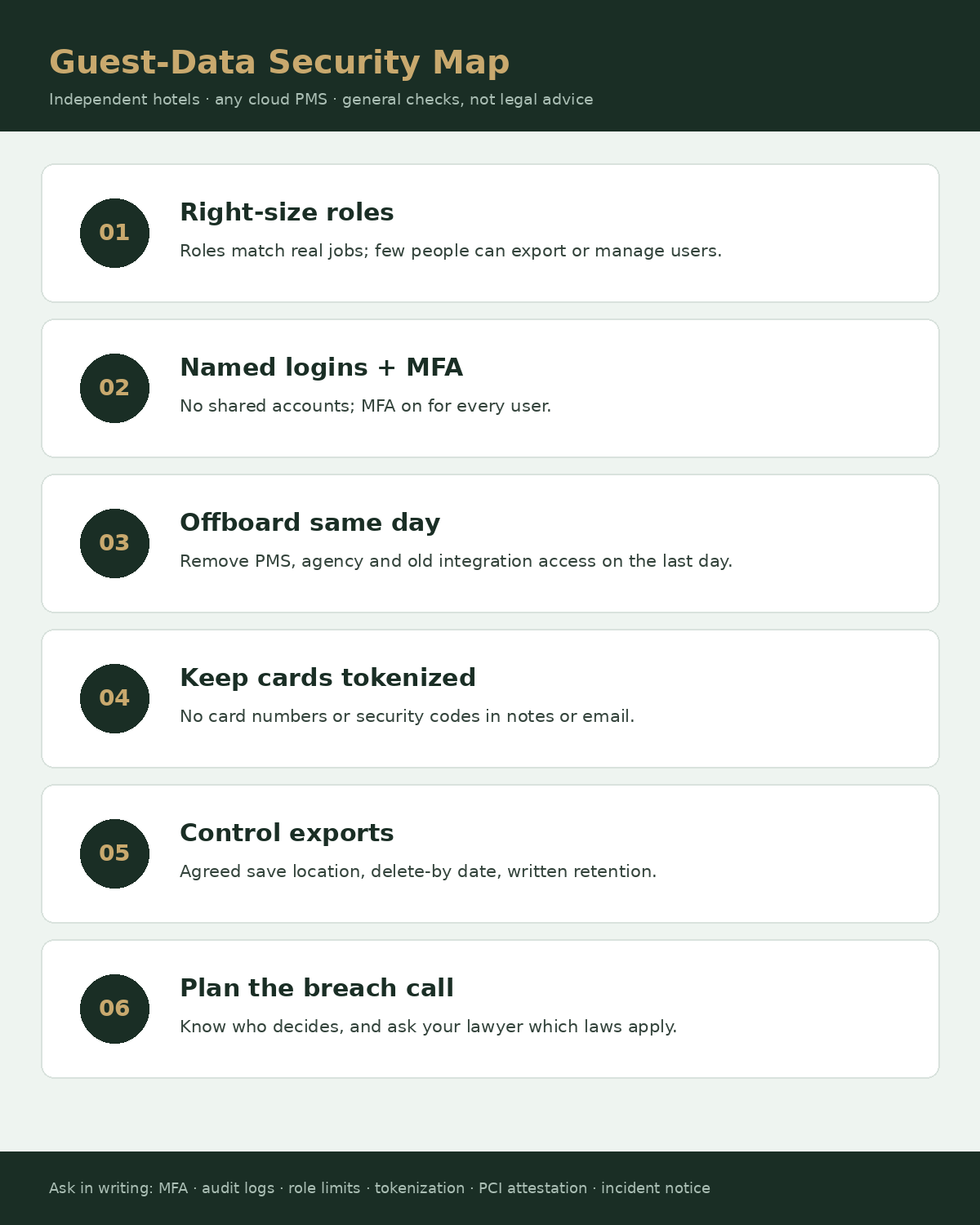
Start with what the FTC calls the principle of least privilege: each employee gets access only to what their job needs (FTC guide). Build PMS roles around real jobs (front desk, night audit, housekeeping, accounting, owner) instead of copying the manager’s role for everyone.
Oracle documents OPERA Cloud roles as based on job title or responsibilities, with access granted through tasks assigned to each role, at chain or property level (Oracle). Cloudbeds has a separate privilege to view sensitive guest information, which stays obscured without it. It says Export Reservation List “should be granted with discretion,” and that activity logs, enabled by default for new roles, “can contain guest and financial details” (Cloudbeds Help).
✓ How to check
List every active user and their role. For each role ask: does this job need full guest details, exports, payment changes or user management? Remove what nobody can justify.
2Logins: no sharing, MFA on, same-day offboarding
A shared “frontdesk” login defeats every other control: you cannot tell who changed a profile, or remove one person without locking everyone out. Give every person, including seasonal staff, a named login.
Turn on multi-factor authentication (MFA). The US Cybersecurity and Infrastructure Security Agency explains that MFA makes access harder even when a password has been phished (CISA). Cloudbeds documents passkeys and authenticator apps, advises against SMS or email as the main method, and adds an extra check before exporting reservations to a spreadsheet (Cloudbeds Help). Oracle describes MFA for OPERA Cloud through sign-on policies and advises periodic audits of identities and administrator roles (Oracle). Mews says it offers 2FA, passkeys, single sign-on and automatic provisioning that can revoke access when staff leave (Mews).
✓ What to do
Put “remove PMS access” on the leaver checklist next to returning keys, done on the last day. Remove old agency, consultant and integration access too.
3Payments: PCI DSS, tokenization and no cards in notes
PCI DSS, the Payment Card Industry Data Security Standard, is a baseline of technical and operational requirements to protect payment account data, maintained by the PCI Security Standards Council (PCI SSC). If you take cards, it applies in some form; your acquiring bank or the payment brands decide how you validate compliance (PCI SSC FAQ).
Two rules matter most at the desk. The 3- or 4-digit card verification code must not be stored after authorization, even for card-on-file use or with the guest’s permission (PCI SSC). And tokenization replaces the card number with a non-sensitive token (PCI SSC guidelines), so staff can charge a stored card without seeing it. Cloudbeds and Mews both say card details are tokenized (Cloudbeds, Mews).
Tokens only help if staff do not work around them. Common leaks: card numbers typed into reservation comments, card details in email threads, or photos of cards and registration forms on a desk computer.
✓ How to check
Search notes and comments for long digit strings and words like “visa” or “cc.” Remove what you find using your vendor’s guidance, retrain the team, and ask your payment provider for a secure way to take cards by phone.
Changing PMS? Card tokens often cannot move between gateways; see our guest-data migration guide.
4Exports, reports and retention
Most guest data leaves a PMS through ordinary exports: a group rooming list, a marketing file, a report emailed to an owner. Once it is a spreadsheet on a laptop, PMS permissions no longer protect it.
The FTC’s business guide puts it in five steps: take stock, scale down, lock it, pitch it, plan ahead (FTC). Its Marriott order also required keeping personal information only as long as reasonably necessary for the purpose it was collected (FTC).
✓ What to do
Limit who can export, agree where exports are saved and when they are deleted, and write down how long you keep profiles, ID scans and old folios. Ask your vendor which purge tools exist.
5Privacy-law pointers (ask your lawyer)
Which laws apply depends on where you operate and where guests come from. Treat this as questions for your lawyer, not legal advice.
| Region | Starting point | Breach rules in official guidance |
|---|---|---|
| Canada | PIPEDA (Privacy Commissioner); Alberta, BC and Quebec have similar provincial laws | Report breaches with a real risk of significant harm, notify people, keep records of all breaches for two years |
| EU | GDPR, via your national data protection authority | Notify within 72 hours unless unlikely to result in a risk; document every breach |
| US | State breach laws; FTC on reasonable security | All 50 states, DC, Guam, Puerto Rico and the Virgin Islands have breach-notification laws |
Sources: OPC breach guidance, PIPEDA in brief, EDPB, NCSL.
✓ Ask your lawyer
Which laws cover guests from other provinces, states or countries? Who decides whether a breach is reported? How long must we keep folios for tax, and how long should we keep marketing data?
6Questions to ask your PMS vendor
Your vendor runs the platform; you control most settings. Ask in writing and keep the answers:
- Can we require MFA for every user?
- Can we see each user’s last login and an audit log of who viewed, changed or exported guest data?
- Which roles can see full guest details, card data and exports, and can we restrict each one?
- Are cards tokenized, and can you share your current PCI DSS attestation?
- Where is our data hosted, and which tools exist to purge old profiles?
- How fast will you tell us about a security incident affecting our data?
For a formal security or PCI assessment, use your payment provider or a qualified assessor. We help with the PMS configuration side; see PMS issues and engineering.
Guest-data security self-check · about 20 minutes
- Every staff member has a named PMS login (no shared accounts)
- MFA is on for every user
- Leavers were removed on their last day (check the user list now)
- Only a few people can export guest data or manage users
- No card numbers or security codes in notes, comments or emails
- Cards go through your tokenized payment flow, never on paper
- Exports have a save location and a delete-by date
- Retention periods for profiles, ID scans and folios are written down
- Unused integrations and old vendor logins are revoked
- You know who decides whether a breach is reported
Questions hoteliers ask
Is my PMS vendor responsible for keeping guest data safe?
Partly. A cloud vendor secures its platform, hosting and payment processing, and many publish security and PCI information. Your hotel still controls who gets a login, what each role can see and export, what staff type into notes, and how long exports live. Ask your vendor to put its responsibilities in writing.
Can we store a guest’s card for future stays?
Use the tokenized card-on-file feature in your PMS or payment provider, never a written or typed card number. The PCI Security Standards Council says the card verification code must not be stored after authorization, even with the guest’s permission. Ask your payment provider which card-on-file and phone-payment methods they support.
Do small hotels need to comply with PCI DSS?
If you accept payment cards, PCI DSS applies in some form, whatever your size. The PCI Council says acquirers (merchant banks) and payment brands decide how an organization must validate compliance. A tokenized, PCI-compliant payment provider can reduce how much of your hotel’s systems are in scope.
Do we have to report a data breach?
Possibly, and timelines can be short. In Canada, PIPEDA requires reporting breaches that pose a real risk of significant harm. Under GDPR, the authority generally must be told within 72 hours. Every US state has a breach-notification law. Call your lawyer early and keep a written record of what happened.
How often should we review PMS user access?
Review the full user list at least every quarter, and right away when someone leaves, changes role or a vendor relationship ends. Check named logins, MFA status, roles and export rights. Oracle advises OPERA Cloud customers to audit identities and administrator memberships periodically; quarterly is a practical starting rhythm.
About the author
Nishan Consultancy is a Kamloops, BC-based hotel technology consultancy run by Md Nishan Amin, a former hotel operator with 6 years in Canadian hotel operations, including time as Assistant Front Office Manager at Sun Peaks Grand Hotel, working extensively in Opera PMS across front-office operations (reconciliations, inventory accuracy, and system data integrity). It fixes PMS and channel-manager issues (Cloudbeds, Opera 5, Mews, SiteMinder) and builds booking-ready websites for independent hotels in the US and Canada.
Works hands-on with Cloudbeds and Opera 5; Mews and SiteMinder supported. Not a security or compliance auditor.
Want a second pair of eyes on your PMS settings?
Our audit includes a PMS configuration review and a written report. If guest-data access is your worry, say so when you book.
30-minute call
Free until Nov 30, 2026 (regularly $200)
Sources
- PCI SSC — PCI DSS (what PCI DSS is).
- PCI SSC — FAQ: storing card verification codes (no storage after authorization).
- PCI SSC — PCI DSS Tokenization Guidelines (PDF, 2011) (tokens replace card numbers).
- PCI SSC — FAQ 1574 (acquirers and brands set assessment needs).
- Cloudbeds Help — Role privileges (sensitive data, exports, activity logs).
- Cloudbeds Help — Multi-Factor Authentication (MFA methods, export checks).
- Cloudbeds — Cloudbeds Payments (tokenization).
- Oracle — OPERA Cloud: About Roles (roles and tasks).
- Oracle — OPERA Cloud Identity Management: Security Guidelines (MFA, identity audits).
- Mews — Security at Mews (vendor statements: 2FA, provisioning, tokenization).
- US FTC — Action against Marriott and Starwood (Oct 9, 2024) (344 million customers; retention).
- US FTC — Protecting Personal Information: A Guide for Business (least privilege; five steps).
- CISA — More than a Password (MFA).
- Office of the Privacy Commissioner of Canada — Mandatory breach reporting (report, notify, two-year records).
- Office of the Privacy Commissioner of Canada — PIPEDA in brief (principles; provincial laws).
- European Data Protection Board — SME guide: data breaches (72 hours; breach records).
- NCSL — Security Breach Notification Laws (all 50 states).
- IBM — Cost of a Data Breach Report 2026 (US$4.99M global average).